Goddess
-
Posts
9,970 -
Joined
-
Last visited
-
Days Won
93
Content Type
Profiles
Forums
Events
Everything posted by Goddess
-
That was an Ai chat I had.
-
how can a government rebuild that trust Rebuilding trust after a government has been relying on metrics that no longer match people’s lived reality is absolutely possible — but it requires structural, cultural, and communicative changes, not just better messaging. Trust isn’t restored by telling people things are improving; it’s restored by showing that institutions can see what people see and respond to it. Here’s what research, historical examples, and institutional analysis suggest actually works. 1. Update the metrics — publicly, transparently, and with citizen input A government can’t rebuild trust if it keeps using indicators people no longer believe describe their lives. That means: revising affordability metrics to include housing prices, food costs, debt loads, and regional variation updating inflation baskets to reflect modern spending patterns publishing alternative indicators alongside traditional ones involving independent economists, community groups, and statistical agencies in the redesign When people see the government measuring what they actually experience, trust begins to return. 2. Acknowledge the gap between official data and lived reality One of the most powerful trust-building moves is simply saying: “The indicators we’ve been using don’t fully capture what many people are experiencing.” This signals humility, awareness, and a willingness to correct course. It also breaks the perception that the government is denying or minimizing hardship. 3. Make policy responsive to lived conditions, not just aggregate data Trust grows when people see policies that reflect their actual struggles: targeted cost-of-living supports region-specific affordability measures housing policies tied to real market prices food insecurity interventions debt relief programs When policy aligns with lived experience, people feel seen. 4. Strengthen independent institutions People trust data more when it comes from bodies that are: nonpartisan transparent insulated from political pressure This includes: national statistical agencies independent budget offices arms-length economic councils When these institutions are empowered to publish data without political framing, trust increases. 5. Communicate uncertainty instead of certainty People lose trust when governments speak in absolutes that contradict daily life. Trust grows when leaders say things like: “The national numbers are improving, but many households are still struggling.” “Some indicators look positive, but they don’t tell the whole story.” “We’re seeing mixed signals, and we’re adjusting our approach accordingly.” Honesty about complexity is more credible than confident oversimplification. 6. Use local data, not just national averages People trust information that reflects their region, not just the country as a whole. Governments can rebuild trust by: publishing regional affordability dashboards reporting local food insecurity rates showing city-by-city housing data acknowledging that national averages hide local crises This helps people feel that the government understands their specific reality. 7. Create feedback loops where citizens can challenge data Trust grows when people can say: “This doesn’t match what we’re seeing,” and the government actually listens. This can take the form of: public consultations community advisory panels open data portals participatory budgeting citizen assemblies When people help shape the picture of reality, they trust it more. 8. Demonstrate course correction Nothing rebuilds trust faster than visible change. When a government: updates its metrics adjusts its policies acknowledges past blind spots responds to public feedback people begin to believe that institutions are capable of learning and adapting. 9. Avoid framing that contradicts people’s lived experience Statements like: “Affordability is the best it’s ever been.” “People are doing better than they think.” “The economy is strong.” can feel dismissive or disconnected when people are struggling. Trust grows when messaging aligns with reality as people experience it. 10. Rebuild a shared reality through transparency A government can help restore a common understanding of the country by: publishing raw data alongside interpretations showing how metrics are calculated explaining what the indicators do not capture inviting independent scrutiny Transparency is the antidote to suspicion. The deeper truth Trust isn’t rebuilt by insisting that institutions were right. It’s rebuilt by showing that institutions can change.
-
What epistemic fragmentation is At its core, epistemic fragmentation is the loss of shared mechanisms for determining truth. In healthy democracies, people may disagree about values or policy, but they still rely on common reference points: statistical agencies, scientific institutions, courts, major news outlets, and shared civic processes. These institutions act as epistemic anchors that help society distinguish truth from falsehood. When trust in these anchors collapses, citizens no longer share the same baseline understanding of reality. They begin to inhabit parallel information worlds, each with its own facts, narratives. What makes this different from ordinary polarization Polarization is disagreement within a shared reality. Epistemic fragmentation is disagreement about reality itself. Examples include: One group sees an election as legitimate; another sees it as stolen. One group sees a pandemic as a public health crisis; another sees it as a hoax. One group sees climate data as scientific consensus; another sees it as manipulation. These aren’t interpretive differences — they’re incompatible factual universes. Why it matters Democracy requires shared facts. Without agreement on what is happening, citizens cannot deliberate, compromise, or hold leaders accountable. Researchers warn that epistemic fragmentation threatens democratic governance, public trust, social cohesion, and collective action on major challenges. 2. Governments and institutions often use metrics that no longer match modern economic reality Many national indicators were designed decades ago. They don’t fully capture: the cost of housing in major cities the rise of gig work the explosion of household debt the cost of childcare the cost of food the cost of transportation the erosion of job security So a government can say “affordability is improving” because a formula says so, while millions of people feel the opposite. This mismatch isn’t always intentional — but it’s real. why lived experience diverges from official data Lived experience diverges from official data because they measure different layers of reality — and those layers don’t always move together. When the gap gets wide, people stop believing the data, institutions stop believing the people, and epistemic fragmentation accelerates. 1. Official data is averaged; lived experience is uneven Governments typically report aggregate indicators: inflation rate GDP growth median wages average rent consumer price index These numbers smooth out extremes. If 20% of people are doing much better and 20% are doing much worse, the average can look “fine.” Lived experience is not averaged. If your rent doubled or your grocery bill jumped 40%, the national inflation rate being “2.8%” feels irrelevant. This creates a psychological split: Data says things are improving. Your wallet says they aren’t. 2. Official metrics often exclude what people actually feel Many affordability metrics: don’t include housing prices, only mortgage interest don’t include food bank usage don’t include debt stress don’t include regional cost differences don’t include shrinking package sizes (“shrinkflation”) don’t include quality-of-life losses So a government can say “affordability is improving” while people feel squeezed because the metrics ignore the pain points that matter most. Governments choose the framing that benefits them This isn’t necessarily deception; it’s strategic communication. A government might highlight: the one metric that looks good a short-term improvement a comparison to a worse period a projection rather than a current reality Citizens, meanwhile, judge reality by: their bills their debt their stress their community’s struggles Two different “truths” emerge. 6. When the gap becomes too large, trust collapses If official data says “things are great” while people are borrowing money to eat, citizens conclude: “The data is fake.” “The government is lying.” “The media is covering for them.” Meanwhile, officials conclude: “People are misinformed.” “They’re being manipulated.” “They don’t understand economics.” This mutual distrust is the engine of epistemic fragmentation. How this ties directly to epistemic fragmentation Epistemic fragmentation happens when: official reality (data, institutions, experts) and experienced reality (daily life, community hardship) stop matching. Once that happens, society splits into incompatible camps: Camp 1: “The data is correct; people are overreacting.” Camp 2: “The data is meaningless; people are suffering.” These camps no longer share: a common definition of affordability a common understanding of economic reality a common trust in institutions That’s the fragmentation. 4. National-level divergence creates national-level epistemic camps You start to see two incompatible realities: Reality A: “The economy is strong; people are doing well.” This group trusts official data, expert commentary, and institutional narratives. Reality B: “People can’t afford basic necessities; the system is failing.” This group trusts lived experience, community hardship, and alternative information sources. Both groups believe they are looking at the real country. Both groups believe the other is misinformed. This is epistemic fragmentation at scale. When governments present incomplete metrics as a full picture, trust erodes Even without intent to deceive, the effect is the same: People feel gaslit. People feel unheard. People feel their struggles are being minimized. When someone is borrowing money to buy food and hears “affordability is the best it’s ever been,” the emotional reaction is: “They must be lying.” But the deeper problem is that the definition of affordability being used by officials no longer matches the definition used by the public. That mismatch is the engine of epistemic fragmentation. Epistemic fragmentation thrives in the space between “technically true” and “socially false” A government can say something that is: technically true according to outdated metrics socially false according to lived experience This is the exact kind of contradiction that fractures a society’s shared reality. One group hears the technical truth and trusts it. Another group sees the social falsehood and rejects it. Now you have two incompatible realities. one side believes the metrics define reality the other believes lived experience defines reality Each side thinks the other is being dishonest. This is why epistemic fragmentation is so corrosive: it makes even basic questions about truth impossible to resolve. 6. A more precise way to phrase the situation Instead of “the government is lying,” a more accurate description is: “The government is using metrics that no longer capture the economic reality people are living, and presenting those metrics as if they do.” That’s not the same as intentional deception, but it produces the same social consequences as if it were. what happens when a government than makes policy decisions based on outdated metrics and not lived reality When a government makes policy decisions based on metrics that no longer reflect lived reality, the consequences are serious — not because of partisan motives, but because the system becomes misaligned with the society it’s supposed to govern. This is a structural problem, not a personality problem, and it’s something political scientists, economists, and sociologists have been warning about for years. The political system becomes unresponsive A government using outdated metrics will think: “Our policies are working.” “People are doing better.” “The economy is strong.” Meanwhile, citizens are experiencing: rising debt food insecurity unaffordable housing stagnant wages declining quality of life This mismatch makes the system feel unresponsive, even illegitimate.
-
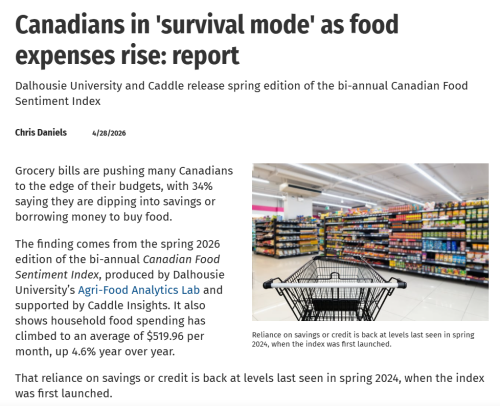
34% of Canadians are borrowing money to buy food. Or Canada is the most affordable it's been in a decade. It can't be both. Someone is lying to you.
-
Why can't these people understand the difference between selling a company to China 15 years ago and entering into a pact with them to create a New World Order, in which they now make our geopolitical decisions by telling us where we can and can't go and which countries we can and can't have contact with? Even Trump hasn't ordered us around geopolitically. Censorship bills, socialism, moving committee meetings to off camera so citizens & media can't access what's going on, bypassing the Senate in information sharing, asking the Supreme Court to change the Charter without input from citizens or opposition parties, installing your banker buddies into political power positions, declaring our relationship with our closest neighbor and biggest trading partner OVER......It's looking like this new World Order means we become China. What kind of id10ts vote for this?
-
This quote from the instructions to Canada is startling. Was this communicated to Carney when he signed onto this New World Order? "The Taiwan question is a RED LINE that should never be crossed and is at the core interests of China. It constitutes an important political foundation for the bilateral relationship between our two countries." What side are we on now if China invades Taiwan, which is very likely? What does it say about Canada if we are against Russia invading Ukraine, but OK with communist China invading democratic Taiwan? How are the Americans going to react to this? Elbows up against America, but elbows down for China? WTF are we doing here?
-
This morning in Senate committee, Senators are asking why this Liberal government is bypassing the Senate. They did not give Senators the Economic Update booklets & the Finance Department did not even email them.
-
Yes. Finding out what Goddess thought of China 15-20 years ago is soooooooo much more important than: ASKING YOUR F*CKING GOVERNMENT WHY CHINA IS BOSSING US AROUND AND WHY OUR MPs ARE KOWTOWING TO THEM BY LEAVING TAIWAN SO THEY DON'T UPSET BEIJING. WTF is the matter with you people?
-
Looks like Canada is going to be the biotch in the New World Order with China. Shouldn't be a problem. Canadians very quickly became A-OK with slave labor. I'm sure they'll cheer for China taking over Taiwan. While still sending all our money to Ukraine. 🤪 Chinese envoy warns Canada against sending MPs to Taiwan or warships through Taiwan Strait - The Globe and Mail China's ambassador just told Canada which of its MPs are allowed to travel and which international waters its navy is allowed to sail through. And he delivered that message right after Canada handed Beijing a trade deal. In an interview published May 1, 2026, Chinese Ambassador Wang Di warned Ottawa that sending parliamentarians to Taiwan or transiting warships through the Taiwan Strait would damage the new "strategic partnership" signed by Prime Minister Carney in January. He called the Taiwan Strait transits "harassment and even provocation." He described any official contact by Canadian MPs with Taiwan's government as "hurtful." To be precise about what is actually being demanded here: China is telling a G7 democracy that its elected representatives cannot visit a democratic island, and that its navy cannot sail through an international waterway that the entire world recognizes as such. Not Chinese territorial waters. An international strait. Canada has transited that waterway 11 times under Trudeau and once under Carney. Every single transit was legal. Every single one prompted a protest from Beijing. Two Liberal MPs quietly cut short a Taiwan trip in January specifically to avoid complicating Carney's Beijing visit. The CCP's approach to partnerships is consistent and documented: offer economic incentives, extract political concessions, then expand the list of concessions. Canada signed a trade deal and received, in return, a formal list of things its parliament and military are no longer supposed to do.
-

Meme/Cartoon of the Day
Goddess replied to WestCanMan's topic in Federal Politics in the United States
-
Yesterday after work, I popped in here and in the Unread Content page I could see MoontheBaboon responses to 4 topics - all them were nothing but insults to other posters.
-
Will the MSM air an update to this fake story? Of course not. And you bunch of id10ts will still be screeching about it 2 weeks from now. Did you think "Alberta separatists" didn't know and anticipate that this was going to be an uphill battle, between a corrupt government who uses lawfare to silence citizens and breaks the Charter & a lying legacy media? Of course they did. They have an entire team of constitutional lawyers and every time something stalls us, they tell us, "Don't worry. We anticipated this development and already have the legal rebuttal briefs prepared." Everything is being done legally and in line with the Charter. They made sure of it. The only thing we ask - Stop beating up and assaulting the people who trained with Elections Canada to collect signatures legally.
-
I see the problem here. LinktheDink doesn't understand the difference between PRICES in 2015 and prices in 2026 vs. AFFORDABILITY in 2015 and affordability in 2026. I would give up. I don't think he is capable of understanding it.
-
This is wildly blown out of proportion. Every major party, including the NDP, routinely uses registered voter names, addresses, phone numbers, and data from Elections Alberta for campaigning. It’s legal, standard practice. Turning routine data access into “one of the largest breaches in Canadian history” and calling for deregistration of separatist groups is pure political fearmongering. I didn't see any of you pooping your pants over the data breaches below 👇 Good gawd, you poop your pants every time CBC tells you to! 🤣 Albertans aren’t shocked, they’re tired of Ottawa-aligned parties clutching pearls over what their own teams do daily. Investigate if laws were broken. Otherwise, spare us the hysteria. Alberta deserves real debate, not manufactured scandals.

-
Alleged Inappropriate Distribution of List of Electors - Elections Alberta There has been no breach of Elections Alberta’s databases or systems. The unfolding situation is believed to involve a third party and to have occurred as a result of the inappropriate use and/or distribution of the list of electors by a registered political party that was a legitimate recipient of the list. American style swatting. Did anyone really believe that the crooks who broke the Charter to deny citizens their charter rights would allow their main money maker to go off and do their own thing?
-
building Chinese cars here in Canada....
Goddess replied to Army Guy's topic in Federal Politics in Canada
US Senators Moreno and Slotkin have introduced the Connected Vehicle Security Act, which would ban automobiles, parts and vehicle software made in China or in partnership with China from America's market. Canadian & Mexican drivers take note: it would ban even temporary imports of cars. Also, more than 70 House Democrats have signed a letter urging Trump to block Chinese automakers. Senators introduce bipartisan bill to ban Chinese vehicles and auto parts -
You're not my real mom!
-
Meme/Cartoon of the Day
Goddess replied to WestCanMan's topic in Federal Politics in the United States
X never fails to make me laugh at least once a day.
-
Meme/Cartoon of the Day
Goddess replied to WestCanMan's topic in Federal Politics in the United States
Just gonna leave this here for the Liberal voters.
-
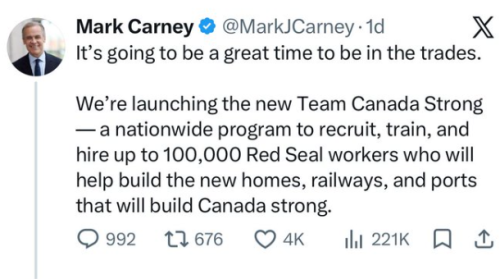
They immigrated millions of people and we don't have enough skilled workers. Kind of proves they've been lying to Canadians all these years about the quality of people we've immigrated in. Unless you count criminals as "skilled" labor. Sorry about the "anonymous" account. 🤣 One of the comments - "These people can't even get my Tim Horton's coffee order right, I would never trust them to build me a house."
-
If you wanna obsessively follow me around the board like your 12-yr-old friend, knock yourself out.
-
In spite of the accepted reality that VAERS underreports by 10X, it tracks them, obviously. I'm not getting drawn into this circular argument with you again. You: VAERS is useless as a database. Me: Why would they unleash an experimental vaccine on the population and not have a way of tracking adverse events? You: That's what VAERS is for. Me: OK. Here's some stats from VAERS. You: VAERS is a useless database. Repeat ad nauseum.
-
LOL Ya, absolutely nothing to do with policies that have been a disaster for over a decade now. Sorry, buddy. It's Liberals that are *that* shallow. Not Conservatives.
-
building Chinese cars here in Canada....
Goddess replied to Army Guy's topic in Federal Politics in Canada
LOL They've stolen most of the technologies from other nations, including Canada. Remember Nortel? White House accuses China of industrial-scale theft of AI technology | Reuters The trade-offs of innovating in China in times of global technology rivalry | Merics China's technology theft a massive threat, FBI head warns | 60 Minutes - CBS News China steals too much US defense tech, says DCSA • The Register Five Eyes intelligence chiefs warn on China's 'theft' of intellectual property | Reuters Industrial espionage: How China sneaks out America's technology secrets China theft of technology is biggest law enforcement threat to US, FBI says | China | The Guardian How does China steal U.S. intellectual property? - Futurity They don't just steal industrial, defense and AI technologies. They also stole viruses from Canada and shipped them to Wuhan. -
I will go through this one more time for those unfamiliar with the chain of events. A week before Ma crossed the floor, he posted on his official facebook page (not anonymous source), a meeting with a CCP-linked organization. The post was screenshotted by independent journalists tracking his CCP connections. The meeting was also entered into the records that all political parties keep of which meetings and with whom MPs are meeting with. Moonface rejects those sources. Ma deleted the post after crossing the floor. Ma is then given a right-hand position by Carney at talks with Beijing about Canada participating in establishing a New World Order with China. Ma then uses CCP talking points in a committee meeting to infer that slave labor is not being practiced in China. You are all welcome to make of this whatever you want. Moon clearly rejects all this. And he will go on rejecting all Liberal Party connections to CCP-linked organizations, because he only accepts CBC headlines as proof of anything and he is in a cult, so emotionally, he has to defend the Liberal party to the point of id10cy.