
ExFlyer
-
Posts
12,028 -
Joined
-
Last visited
-
Days Won
1
Content Type
Profiles
Forums
Events
Everything posted by ExFlyer
-
HA HA HA You no like...Awww too bad...so sad LOL I love that it bothers you so much.... Here is another... LOL
-
Fact is, Iran is what it is as a result of American interference form way back since 1953 and it has been interfering with Iran ever since. Now the US is pissed off that Iran does not like the US. You say Britain made Israel and Pakistan,...well, the US made Iran what is today. "The Era of Alliance (1953–1979) For 26 years, Iran was the United States' primary ally in the Middle East. 1953 CIA-Backed Coup: The U.S. and UK orchestrated the overthrow of democratically elected Prime Minister Mohammad Mosaddegh after he nationalized the oil industry. Mosaddegh was the last democratically elected Prime Minister in Iran. The US then restored absolute power to Shah Mohammad Reza Pahlavi, a move many Iranians still view as the root of modern animosity. "Atoms for Peace" (1957): President Eisenhower launched Iran’s nuclear program, providing the country with its first reactor and enriched uranium for civilian use. The Twin Pillars: Under President Nixon, Iran and Saudi Arabia became the "twin pillars" of U.S. strategy to contain Soviet influence in the region. The Revolutionary Break (1979–1981) 1979 Islamic Revolution: Widespread opposition to the Shah’s authoritarianism led to his exile and the return of Ayatollah Ruhollah Khomeini, who established a theocratic Islamic Republic and labeled the U.S. the "Great Satan". Hostage Crisis (1979–1981): Iranian students stormed the U.S. Embassy in Tehran, holding 52 Americans hostage for 444 days. This led the U.S. to sever diplomatic ties and impose its first sanctions. Decades of Shadow War (1980s–2010s) Iran-Iraq War (1980–1988): The U.S. officially remained neutral but secretly provided intelligence and economic aid to Iraq. Direct Skirmishes: In 1988, a U.S. warship mistakenly shot down Iran Air Flight 655, killing 290 civilians. "Axis of Evil": Following the 9/11 attacks, President George W. Bush labeled Iran part of an "Axis of Evil" due to its nuclear ambitions and support for regional proxies like Hezbollah. Nuclear Deal (2015): The Obama administration reached the Joint Comprehensive Plan of Action (JCPOA), which limited Iran's nuclear program in exchange for sanctions relief. Escalation to Open Conflict (2018–Present) [1] Trump’s "Maximum Pressure": In 2018, the U.S. unilaterally withdrew from the nuclear deal and reimposed crushing sanctions. Tension spiked in 2020 when a U.S. drone strike killed Iranian General Qassem Soleimani. 2025 Nuclear Strikes: Citing a breach of nuclear obligations, the U.S. and Israel bombed three key Iranian nuclear facilities in June 2025. Operation Epic Fury (2026): In February 2026, the U.S. launched a large-scale military campaign aimed at "regime change". Recent strikes have targeted top leadership, including Supreme Leader Ayatollah Ali Khamenei, who was reportedly killed during the offensive." And to this day, "The United States maintains a significant military presence in the Middle East, with 40,000 to 50,000 troops stationed across at least 19, and up to nearly two dozen, distinct military sites . These include eight primary, long-term bases located in countries such as Qatar, Bahrain, Kuwait, and Saudi Arabia, alongside numerous temporary or supporting locations" And that is not including all the sea power they have there. Ya think that kind of presence and influence had no effect??? Control your emotions LOL Mellow out....Take a pill LOL
-
Wow...what a bunch of rhetoric. Clearly you are a racist and can not take being told that Americans are as much to blame for the shit over there as Israel or any of the middle eastern countries.
-
"Here the real detailed & verified information with links provided that Pierre Poilievre doesn't ever tell the Canadian people for it doesn't fit his narrative. As of early 2026, all provinces and territories have signed the foundational Canadian Free Trade Agreement (CFTA), but some, notably Quebec, have lagged in fully implementing changes, receiving lower ratings for reducing specific, often protectionist, internal barriers, notes this Public Policy Forum report. While Alberta and Saskatchewan have utilized Memorandums of Understanding (MoUs) rather than new, fully binding, comprehensive legislation in some cases, the core issue remains a decentralized system allowing significant local regulatory control. * Lagging Jurisdictions: Quebec was identified as having the most restrictive, or "last place," policies regarding interprovincial trade in 2024–2025. * Voluntary Mechanisms: Alberta and Saskatchewan, while active in the New West Partnership Trade Agreement (NWPTA), have relied on MoUs with other provinces, such as Ontario, to address specific barriers, which are not always as binding as formal legislative changes, notes TD Economics. * Reasons for Slow Progress: The Canadian constitution and a decentralized federal system allow provinces significant autonomy to regulate trade within their borders, often leading to protectionist policies that favour local, or provincial, interests." " Some provinces have gone further than others, with Ontario, Nova Scotia and Manitoba arguably pushing the furthest. However, PEI and B.C. have recently signed legislation aimed at enhancing trade. On the opposite end, New Brunswick and Newfoundland and Labrador have been more cautious. Quebec also stands out in that it’s the one government yet to sign an MoU with any province, but has introduced legislation to make interprovincial trading freer, subject to criteria. While gains from interprovincial trade should manifest from these actions, their magnitude will be restricted by several factors, including the fact that not all provinces have trade agreements. Moreover, geographic trade barriers remain, as do others (such as having to navigate complex tax systems). Finally, most firms that trade interprovincially already report doing so obstacle-free. " https://economics.td.com/ca-interprovincial-trade?fbclid=IwY2xjawQiSDJleHRuA2FlbQIxMABicmlkETE0dGNXMXlaQWVIbkVvb001c3J0YwZhcHBfaWQQMjIyMDM5MTc4ODIwMDg5MgABHrxqcFU7Bo1gBra7keEtU35B_nzf7VOBI3s5mp3eS89L3-Rr616WabqXOo9m_aem_D9L3UVyrxozMLvDqVsY0CQ#:~:text=Some provinces have gone further,trading freer%2C subject to criteria
-
What posts? Where? Are you following Hamas propaganda pages and posts? I don't like Hamas but you are just saying unconfirmed and unsubstantiated things.
-
-
BC's Premier David Eby . . . a stalled economy.
ExFlyer replied to Nefarious Banana's topic in Provincial Politics in Canada
BC has been NDP for almost 25 of the past 50 years LOL Never any conservatives. No viable opposition. Ya keep voting them in. Like the liberals get voted in most of the time becasue there is no viable opposition. -
1. Not in Canada...just in Quebec. 2. I have no idea what you expect to get from Alberta or Quebec??? It's tax time...no get ...all pay LOL
-
Canada's (In)Justice System AKA "Thanks, Bill C-75!"
ExFlyer replied to Goddess's topic in Federal Politics in Canada
AI High Perception of Crime: Despite recent year-over-year decreases in some crime metrics, a majority of Canadians (roughly 3-in-5) believe crime has increased in their communities, often influenced by high-profile violent incidents or local increases. Reporting Levels: While police report, not all crimes are reported by victims. The "fear factor" and high-profile reporting can influence the public perception of crime, which sometimes contradicts the nationwide statistical trend, which suggests crime is actually below previous highs from the early 1990s. In summary, violent crime has increased in specific areas over the long term, while overall crime rates have recently fluctuated, generally decreasing in the most recent 2024 data." -
-
Oh, do not underestimate me... I am calling you out on your unsubstantiated BS and, as usual...you deflect and try and make it something else. I have never said policy means noting to me...I have said PP's imaginary policies means nothing to me. LOL
-
HUH??? And what is that??? OH? You have some sort of proof of your accusations?? No? I thought so.
-
Aha!!! A big maybe from you...so you know it all BS LOL I have no idea what you are talking about and suspect strongly suspect you do not either. Seems you have babbled yourself into a corner. LOL
-
All BS!!! More conservative paranoia without cause.
-
"The Liberal government previously mandated that 100% of new light-duty car and passenger truck sales be zero-emission vehicles (ZEVs) by 2035, starting with a 20% requirement by 2026 . However, as of early 2026, reports indicate the government is shifting away from this strict 100% mandate toward a revised target of 75%"
-
The questions are not worth answering. They are typical conservative Sealioning/"just Asking Questions (otherwise known as JAQing off ). Terms describe a tactic of endlessly asking questions to deliberately waste time, acting as if they are seeking answers, but actually preventing progress. No dodging at all, just not worth wasting time debating becasue all you do is a Sysyphean debate LOL
-
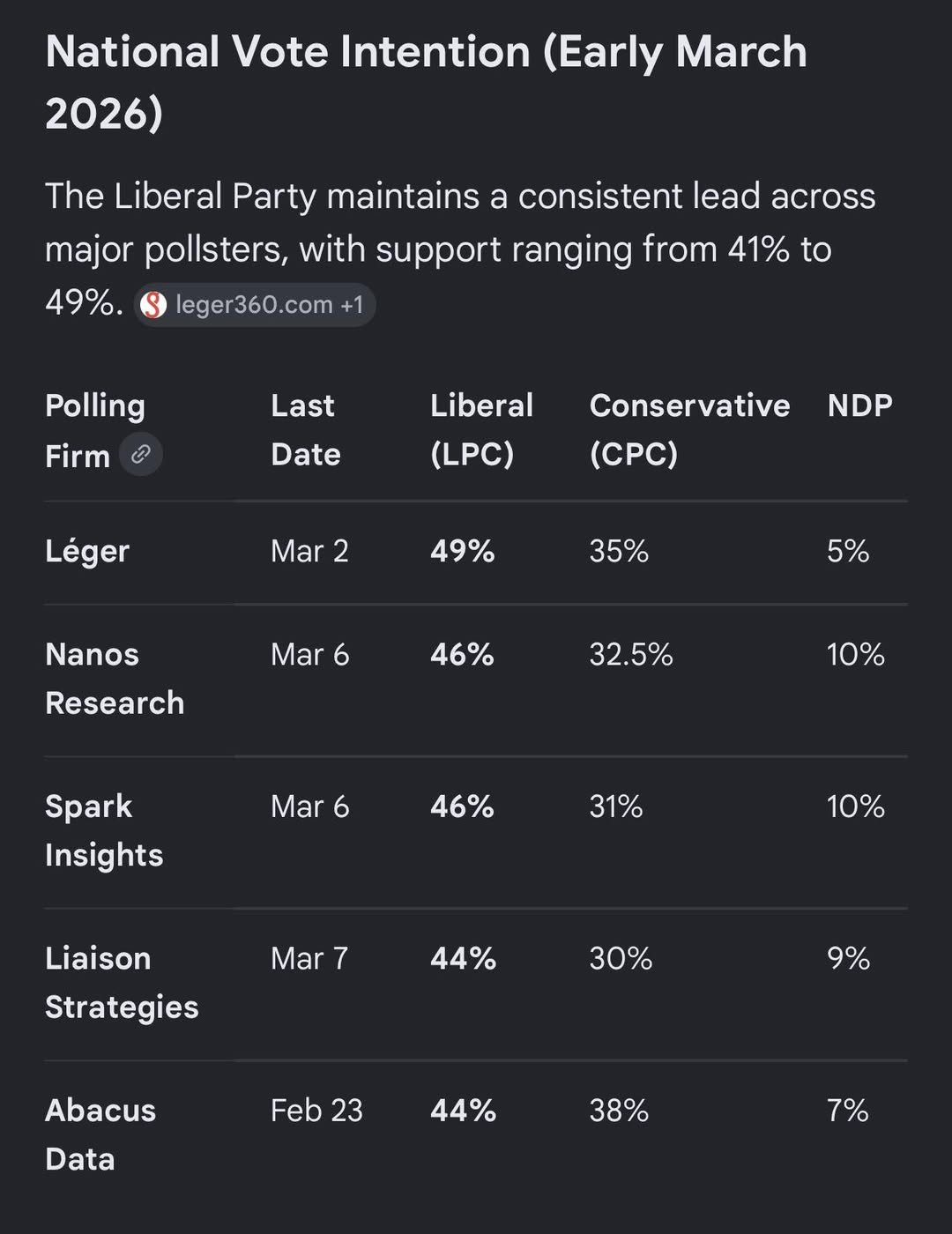
Baloney??? When the conservatives get a leader that has Canadians behind them,...that would be a huge step for them. So far in 4 elections and 3 different leaders they have failed. Admit it, the conservatives are falling behind and cannot get out of the hole they created. LOL 11 years of liberal government should very well tell you what Canadians think of conservative leadership, policies and the party.
-
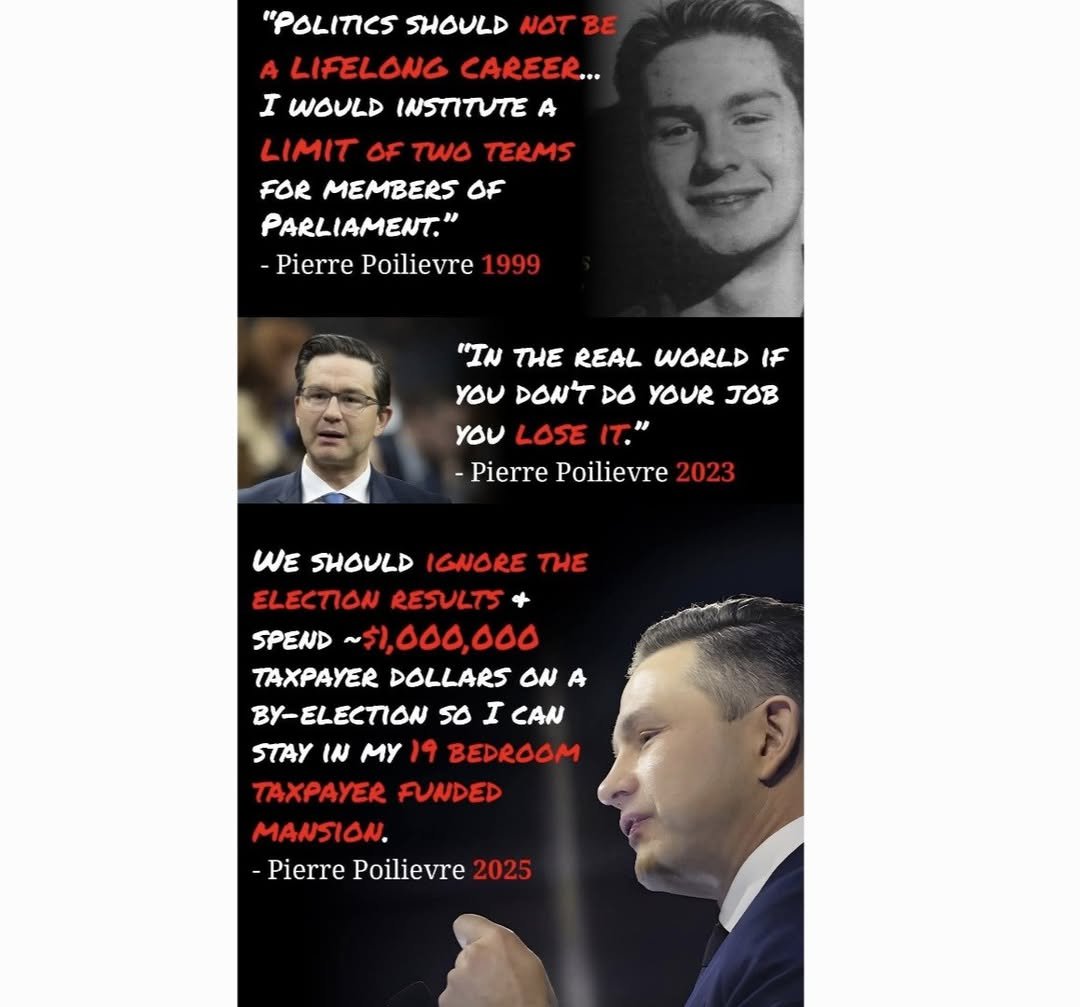
Point? You had a point??? LOL Thing is...all you can do is ask questions...like PP ...useless and unnecessary questions that require no answers. Frightened of who? Polievere the loser? Lost his own seat, made a minion leave to take their seat and now says he will take some other seat in the next attempt?? How can a transient forever politician frighten anyone? LOL HA HA HA says people that have no power, no authority. And yes, as so many of us have said...we would vote for an alternative ....if in fact there was an alternative but....there is not ...only 4 failed leaders in 4 elections LOL So no, not complicated at all...the best political party has won...4 times.
-
Why perpetuate a useless debate?? The Liberals are the government and will remain so until the conservatives find a leader. In the meantime, it is fun watching cons on this forum whine and cry at everything the liberals do and get done and the cons get nothing. The conservative MP's would rather abstain and hide behind curtains than vote so the liberals win. So...keep on keeping on and getting nothing in return LOL
-
And the conservatives got their numbers from where??? The IRGC meeting attendance records? Seems the conservatives can say anything they want without having to back up their accusations and claims. Their reputation for passing false information is gaining traction.
-
I kinda agree. I remember when Ontario tried to make people on welfare to work for their money, Workfare they called it, but the human rights people went so ballistic and got so upset that it was cancelled. Go figure
-
Weapons buying under PM Carney an 'eyewatering increase' for Canada: From a satellite-maker to a company that helps underwater drones tell the difference between a rock and a naval mine, Canada’s humble military supply sector is lighting up the stock market as investors eye billions in new government spending. A new report by Desjardins notes an “eyewatering increase” in weapons purchases since Prime Minister Mark Carney took office last year. As tension mounted with the United States, Ottawa in 2025 committed to its biggest military spending hike since the Second World War. Overall, $81.8 billion in new spending over five years was earmarked to strengthen the Canadian Armed Forces. https://ca.finance.yahoo.com/news/weapons-buying-under-pm-carney-an-eyewatering-increase-for-canada-desjardins-150812340.html
-
Not all, or even most, TFW's work in agriculture. "Key details regarding sectors for temporary foreign workers (TFWs) include: Agriculture: This sector is a primary employer, with TFWs accounting for roughly 17% to 18% of its workforce. Service and Hospitality: Over 10% of workers in accommodation and food services, as well as in administrative and support services, are foreign workers. Manufacturing and Trade: Significant numbers of TFWs work in food manufacturing, retail trade, and transportation and warehousing. Job Concentration: Three sectors—accommodation and food services, retail trade, and administrative/support/waste management—have accounted for over 40% of all TFWs in recent years. "
-
"In Canada, temporary foreign workers (TFWs) are responsible for their own basic living expenses, though specific programs and residency timelines provide access to certain government benefits and employer-provided supports. Rent and Housing Responsibility: Most foreign workers must pay for their own rent. Employer Requirements: For low-wage or primary agriculture streams, employers must ensure "adequate, suitable, and affordable" housing is available. Deductions: Employers may deduct rent from a worker's pay, provided it is outlined in the signed employment agreement and meets provincial limits. Exceptions: In the Seasonal Agricultural Worker Program (SAWP), employers must provide housing at no cost, except in British Columbia where some deductions are permitted. Food and Groceries Responsibility: Workers typically pay for their own food using their wages. Grocery Rebate: Low-income foreign workers who file taxes may be eligible for one-time government "Grocery Rebates" or GST/HST credits to help offset rising food costs. Healthcare Public Coverage: TFWs have the right to free healthcare under provincial/territorial systems (e.g., OHIP in Ontario). Waiting Period: Public coverage often has a waiting period. Employers must buy and pay for private emergency health insurance for the worker until they are eligible for provincial coverage. Employer Costs: Employers are strictly prohibited from deducting these private health insurance costs from the worker's pay. Money for Children (Canada Child Benefit) Eligibility: Foreign workers can receive the Canada Child Benefit (CCB)—a tax-free monthly payment—only after living in Canada for 18 consecutive months. Requirements: To qualify in the 19th month, the worker must: Have a valid permit. Be a resident for tax purposes. Live with the child (under 18) as the primary caregiver. Amounts: Payments are based on family income and the child's age, with maximums around $7,997 per year for children under 6