BeaverFever
-
Posts
7,485 -
Joined
-
Last visited
-
Days Won
35
Content Type
Profiles
Forums
Events
Everything posted by BeaverFever
-
So to recap: the location s reasonable given current needs, far less expensive than comparable alternatives and all or almost all of the cost will be covered by selling the old location More 24 Sussex-style fake hysteria ginned up by the Conservatives
-
Over $6-million price for new Canadian diplomatic residence in New York City no big deal, says realtor … “A $6.6-million sale doesn’t usually get much attention because, in the world of Manhattan real estate, it isn’t a significant price,” Ms. Aries said in a statement Monday, responding to questions from The Globe and Mail. “Properties are selling for a lot more,” added Ms. Aries, who is described on the company website as a “foremost expert in ultra-luxury, full-service branded residences.” …In the Douglas Elliman statement, Mr. Aabo said governments are rethinking their real estate portfolios in New York to focus on long-term strategy as opposed to short-term needs. “Purchasing a diplomatic residence in the Landmark portion of 111 West 57th Street checks all of the boxes: desirable location, security, attractive purchase price and long-term appreciation potential,” he said. …In their statement, the Douglas Elliman realtors noted that the property, located in an area called Billionaires’ Row, was purchased for $1,700 a square foot, which is 70-per-cent less than peer buildings in the neighbourhood. They noted that the most expensive contract signed in the past week was a $26.9-million tower duplex in the same complex. … GAC has said the consul general’s current residence was purchased in 1961 and last refurbished in 1982. It is now being readied for sale and is expected to exceed the purchase price of the new unit, GAC spokesperson Jean-Pierre Godbout said last week. https://www.theglobeandmail.com/politics/article-us66-million-price-for-new-canadian-diplomatic-residence-in-new-york/
-
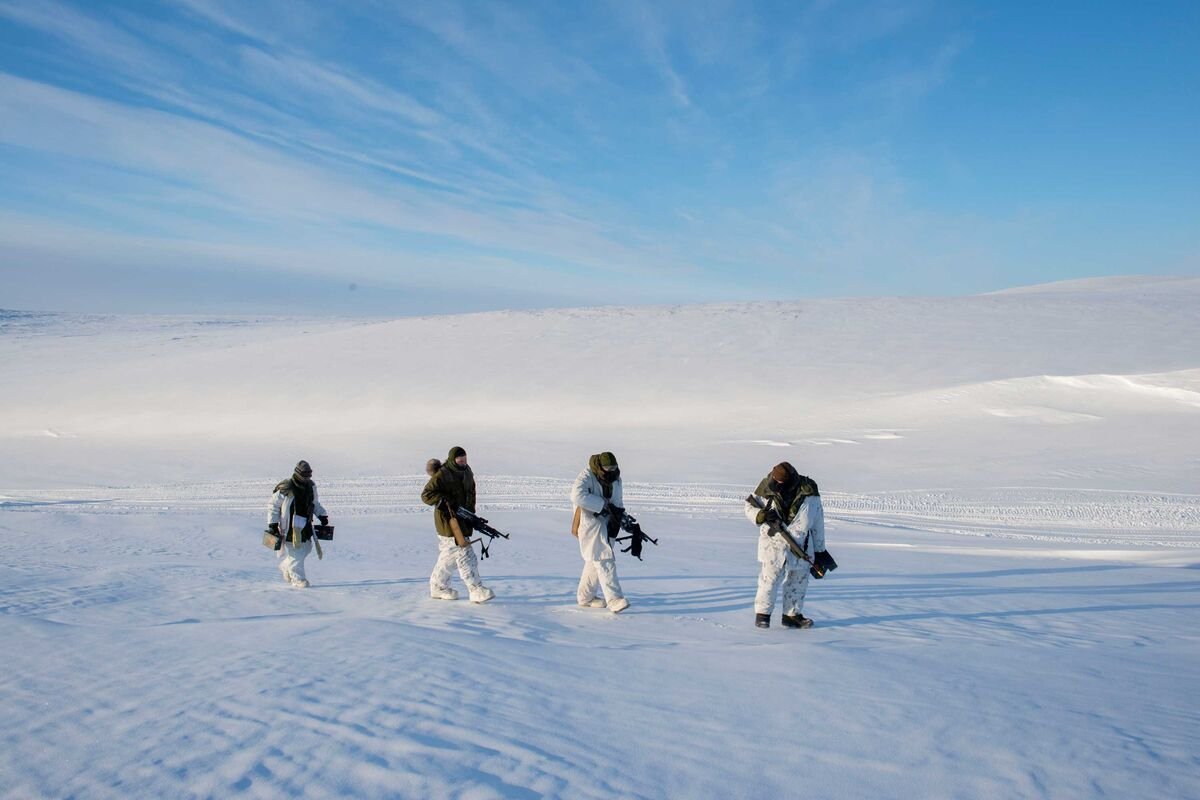
Bloomberg Canadian soldiers during a combat exercise near Resolute Bay, Nunavut, in March 2024. Photographer: Louie Palu/Agence VU Opinion Liam Denning, Columnist How Canada Is Defending the Place With No Dawn Liam Denning spent 10 days in the Arctic, where the Canadian military is preparing to safeguard its vast, unpopulated mineral-rich territory from emerging threats. July 29, 2024 at 5:00 AM EDT By Liam Denning Liam Denning is a Bloomberg Opinion columnist covering energy. A former banker, he edited the Wall Street Journal’s Heard on the Street column and wrote the Financial Times’s Lex column. This is the fifth in a series of articles looking at how climate change and geopolitics are reshaping the High North’s strategic landscape, from the military balance of power to the quest for oil and gas and mineral resources. Photography by Louie Palu. You can watch the video feature here. Standing on a thick layer of sea ice, with vague misgivings about the numbness spreading through my feet, I venture a churlish question to the Canadian infantry officer on whose snowmobile I hitched a ride to this remote spot in the High Arctic: “Why are you wearing green?” We’re waiting for the rest of his patrol in the middle of something like a frosted crater; the windchill is around negative 50F. It is a bright morning in early March in Resolute Bay, Nunavut, barely a thousand miles from the North Pole. Chief Warrant Officer Pierre Ouellet’s camouflage looks more suited to the tree line, the Arctic boundary several hundred miles south. White would be more discreet, surely? He answers: “We want to be seen.” That could be Canada’s unofficial Arctic motto. A year before, I was up a mountainside in Alaska with US Army troops training hurriedly for winter warfare. But the US is a continental superpower with an Arctic fringe. Canada, in contrast, is a middling power fringing an Arctic continent: an expanse of mainland and archipelago that makes up 40% of the country’s territory and 75% of its coastline but hosts less than 1% of the population. Ottawa has long fretted about foreign powers stealing in like squatters to some cavernous, virtually empty penthouse. That penthouse includes most of the North Atlantic Treaty Organization’s Arctic territory and acts as the de facto northern frontier of the US. Long a potential pathway for bombers and missiles in the skies, it also offers a potentially game-changing shipping route between the Pacific and Atlantic oceans — the fabled Northwest Passage. Beneath the permafrost and ever-less-icy waters lies a potential trove of mineral resources, including the building blocks of the energy transition. As climate change and a fracturing international order draw the world’s attention northward, I’ve come to Resolute Bay to watch the Canadian military grapple with the seemingly banal, but hugely complex and expensive, challenge of occupying its own territory and preparing for an emerging great game at the top of the world. Canadian soldiers with snowmobiles and sleds preparing to load into a CC-130 aircraft in blowing snow at Resolute Bay Airport, in March 2024.Photographer: Louie Palu/Agence VU Remote and isolated as it is, Resolute sits in the heart of Canada’s Arctic, making it a key logistical hub: the site of the Canadian Armed Forces Arctic Training Center, which includes the only runway this far north long enough to accommodate giant CC-177 cargo planes. It’s also home to the Polar Continental Shelf Program, supporting scientists in the field, including those involved with mapping out Canada’s entitlements on the Arctic seabed — a latter-day extension of the exploratory mission that gave the bay its name, derived from a British Royal Navy vessel sent in vain to find the doomed Franklin expedition to the Northwest Passage two centuries ago.1 Yet there is another reason Resolute Bay figures prominently in Canada’s effort to assert its sovereignty over its Arctic territory. The isolated hamlet on the bay, Resolute, dates from the 1950s and a dark chapter in the history of Canada’s treatment of the Arctic’s original masters, its Indigenous people. In that feverish early Cold War period, Ottawa coerced, or lured under false pretenses, more than 90 Inuit men, women and children to relocate from elsewhere to Resolute, on Cornwallis Island, and Grise Fiord, a settlement on nearby Ellesmere Island. This was done in part to — you guessed it — reinforce Canadian sovereignty in the Arctic. Ottawa issued a formal apology for the High Arctic relocation in 2010. A little way out of town near Resolute, a stone monument depicts a man looking toward Grise Fiord, where, about 240 miles northeast, stand a stone woman and child with a husky looking back, mute testament to the separation of families that took place. In that context, Resolute’s name in the Indigenous tongue of Inuktitut feels even more apt: Qausuittuq, the place with no dawn. Master Corporal Steve Aulaqiaq, a Canadian Ranger from the Inuit community of Qikiqtarjuaq, teaching igloo construction to non-Indigenous Canadian soldiers at Crystal City, near Resolute Bay, March 2024.Photographer: Louie Palu/Agence VU Yet embedded in that sad beginning also lies a prospective answer to the conundrum of how Canada can exert sovereignty over this harsh and seemingly limitless vista. In Resolute, I saw how Ottawa relies on a largely Indigenous contingent of Canadian Rangers to bolster its Arctic capabilities. Likewise, Ottawa’s commitment to the northern communities from which the Rangers hail, enhancing their resiliency in the face of climate change and other novel challenges, is critical to preserving their presence and the generational knowledge that it underpins. In that respect, Canada’s defense of its sovereignty in the Arctic ultimately rests as much on building a robust and inclusive national identity as it does on fielding a military fit for purpose. Its success in doing so can provide a model from which other Arctic countries, the US included, can learn. Canada’s Arctic Crossroads Resolute Bay sits at the center of Canada’s Arctic territory and sea lanes, about 1,000 miles from the North Pole Sources: Arctic Portal (Northwest Passage); Natural Earth A Desert Made of Water Resolute Bay lies in a polar desert. Stepping off the plane near the training center, a collection of low buildings resembling a moon base, I’m surprised to find myself coughing; the air catches in the throat like an icy dust. I flew in with members of the Royal 22e Régiment, the Canadian Army’s storied Francophone infantry regiment known as the Vandoos (vingt-deux, see?). Some recognize photojournalist Louie Palu, traveling with me, from when he was embedded with them in Afghanistan. For many, this is their first time so far north. A boat on the frozen shoreline of Resolute Bay, in March 2024.Photographer: Louie Palu/Agence VU There are a few short roads around Resolute Bay. Lined with poles and wires covered in a rime of frost like old sailing masts, one runs a mile or so north to a huddle of huts and tents named, with real estate mojo, Crystal City. Three miles south, the road heads into tiny Resolute itself, which has fewer than 200 residents. And that’s it. Cornwallis Island is a small patch of wilderness in Nunavut, the Canadian territory that stretches from Manitoba to the waters off northern Greenland. Averaging 0.05 people per square mile, it is a demographic near-vacuum. In my initial briefing, an officer warns: “If you’re lost in Nunavut and you yell, no one will hear you.” The grim echo of Ridley Scott’s Alien evokes a sense of having landed on a different planet altogether. Canada’s Giant, Lonely Arctic Arctic regions’ share of population and land area [graphic at link] Source: Econor Note: “Nordic countries” includes Greenland, an autonomous territory of Denmark. Greenland’s area excludes its ice cap. Click here to watch the video feature. Maybe that’s why the changing rooms, where you suit up for the outside, feel like an airlock. Besides the cold — the wind chill dips below negative 80F at one point during my visit — dehydration creeps up on you. As Captain Phil Simon, a surgeon and medical officer, tells me, “With every breath, you’re losing water.” Along with biology, medics stationed in Resolute Bay need a doctorate in flight schedules: Even a perfect medevac from here takes about 12 hours. A senior officer in the regional command says it was easier moving casualties from Afghanistan to Germany and then on to Canada than it is getting them out of here. Not to forget: Nanook. No short walk around the complex is complete without doing the occasional 360 to spy any polar bears. Nine are being tracked in the area when I arrive, and the safety tips on posters around the base tend to stoke, rather than allay, anxiety. A homemade effort I found pinned up in a broom closet resonated more: “What doesn’t kill you makes you stronger … except for bears…bears will kill you.” VIDEO: Learning to Fight in Canada's Arctic Territory General Wayne Eyre, who has just retired after serving as Canada’s Chief of the Defense Staff, fully acknowledges that no foreign army is coming over the ice today; if they did, he tells me, “the first capability we would send up is search and rescue.” He is instead looking a decade or two ahead, when more ice has melted and the postwar certainties of sacrosanct borders and free trade, coming apart already, potentially break down completely. In the face of such scenarios, Canada’s military suffers from what one might call diseconomies of scale. The army’s roughly 44,000 regular soldiers, spread across a country a little bigger than the US, would fit inside just one major US Army base, Fort Liberty in North Carolina. Joint Task Force North, responsible for Arctic operations, has around 1,600 personnel today. There is a lot of ground to cover, much of it extraordinarily rugged and lacking basic infrastructure. Corporal Nicolas Villemaire refueling a snowmobile at the Canadian Armed Forces Arctic Training Center in Resolute Bay, March 2024.Photographer: Louie Palu/Agence VU All-out war on the ice may be hard to imagine. But as Omond Solandt, the former head of the Canadian Defense Research Board, observed in 1948, not long before Resolute’s founding, “Everybody knows it’s impossible to fight a war in the Arctic, but we have to prepare for the man who doesn’t know it’s impossible.” So armies must imagine stuff anyway. Incursions by small, specialized forces, or drones — or “weather” balloons — are all too easy to imagine in such open space. As sea ice melts, shipping activity picks up. More than 140 vessels are expected to traverse the Northwest Passage this year. Besides offering another avenue for intrusion, each ship represents a potential search and rescue mission. The seemingly obvious draw is what lies beneath. Gold has been mined in Canada’s Arctic since the Yukon rush of the late 19th century. World-class deposits of uranium, diamonds, iron ore and copper have also been mined, and there are hopes to develop lithium and rare earth metals, too. Meanwhile, the US Geological Survey estimates that perhaps 20 billion barrels-equivalent or more of oil and gas lie beneath the Canadian Arctic. Beyond all this, in several senses, is the tantalizing prospect of one day sucking up rare earths and other minerals from the Arctic seabed. At a military conference in London recently, I heard a senior UK Royal Air Force officer almost casually refer to the seabeds and the poles as “the Klondikes of the 21st century.” Exploiting them is another matter. Besides extreme conditions, sheer remoteness and short working seasons make Arctic mining and drilling time-consuming and expensive. The giant Mary River iron ore mine on Baffin Island, for example, took roughly half a century from initial discovery to first production. For all their potential, Canada’s three Arctic territories lag significantly when it comes to investment in new projects. Canada’s Untapped Arctic Resource projects planned or under construction in Canada’s Arctic and other regions, split by type [graphic at link] Source: Natural Resources Canada 2023 inventory Note: Canadian Arctic comprises the Northwest Territories, Nunavut and Yukon. C$10 billion is about $7.22 billion. Climate change is touted as a catalyst for more. But sinking permafrost, less predictable sea ice and erratic weather patterns are less like the neat click of a long-sealed vault unlocking and more like the wayward swing of a wrecking ball. And yet, even if one knows all this, what if the other side thinks it knows otherwise? Most Klondike gold prospectors found nothing and nonetheless joined the rush. When it comes to imagined futures, the Arctic is not just a blank canvas but a shared one, too. In stretching to protect this region, Canada’s military is hampered not merely by the vast distances but also by its less-than-vast budget. An updated defense strategy — “Our North, Strong and Free” — promises more money, including funds for new Arctic installations and equipment. Announcing Eyre’s replacement General Jennie Carignan as the new Chief of the Defense Staff — the first woman to hold that position — Prime Minister Justin Trudeau noted that her appointment came amid “complicated geopolitics and increased threats, particularly to our Arctic.” Canadian soldiers on snowmobiles pass Crystal City, near Resolute Bay, March 2024.Photographer: Louie Palu/Agence VU Even the new budget remains below NATO’s current target of 2% of gross domestic product, however. Meanwhile, Defense Minister Bill Blair has spoken of the difficulty of convincing Canadians to raise spending further. As P. Whitney Lackenbauer, a professor at Trent University in Peterborough, Ontario, and a leading military historian, puts it: “Many Canadians still see the Arctic as a ‘there’ rather than a ‘here.’” One morning, somewhere in among the low hills near Resolute Bay, I watch reservists — wearing white this time — stage a mock attack on an encampment. They are, for all intents and purposes, capturing a patch of nothingness, blank white ground indistinguishable from the wider horizon. Tactical exercises here, as opposed to survival training, are relatively new for this regiment, reflecting the shifting geopolitical winds. For all the spent casings in the snow, and tactical camouflage, a strong element of psyops is at play. These soldiers are demonstrating to anyone watching, foreign or Canadian, that they can fulfill basic roles in a place that, given half a chance, will kill you without any human intervention. Yet they couldn’t do that were it not for a unique part of the Canadian military, one that ties it in a more profound way to this unforgiving land. Canadian soldiers preparing targets for a firing range near Resolute Bay, March 2024.Photographer: Louie Palu/Agence VU Ranger Time The secret to building an igloo is a spiral. You lay down blocks of hard-packed snow — “like sawing Styrofoam,” a sweating soldier tells me — in a ring and then cut a deep, slanted notch in one of them. That is the sloping start of the wall building up, round and round, higher and higher, to the apex. I am watching Master Corporal Steve Aulaqiaq, clad in a red parka, frost clinging to his mustache, as he slowly disappears, walling himself up inside a white dome. He is a Canadian Ranger. The Rangers, founded in 1947, are a part-time force numbering around 5,000, with about 1,500 of those in the Arctic, most of them Indigenous. They’re not combatants; they are the military’s eyes and ears in the emptier spaces of northern Canada, tasked with seeing something and saying something rather than shooting someone. Yet they are far more than that. They’re teachers, pathfinders, weather experts and, in this setting, even protection from bears. Corporal Anuga Michael from the Inuit community of Pangnirtung, in Crystal City, near Resolute Bay, March 2024.Photographer: Louie Palu/Agence VU That morning when I discussed camo with Ouellet, several Rangers were teaching a squad of Vandoos how to hunt seal and fish through the ice. Most of the Rangers hail from Arctic or sub-Arctic communities to the south. They aren’t superhuman; I see signs of frostnip, especially around the eyes, evidence of wind cutting against exposed skin on long snowmobile patrols. But the Rangers’ acclimatization sets them apart. While I fret about my feet getting frostbite despite triple-layered boots, one Ranger kneels on the ice, pulls off his gloves and reties a sled with bare hands. That sled, called a komatik, is itself a form of Indigenous technology. Wooden runners and cross-pieces are lashed together rather than nailed — an elegantly simple design that makes them sturdy yet with enough give to handle rough Arctic terrain. As a metaphor of the pragmatism and adaptability this place demands, they are hard to beat. The Rangers have a quiet presence. For all the incongruity of the Vandoos’ green camo, it’s the Rangers’ outfits that I’ll remember: seal-fur gloves, a bristling coat fashioned from nearly 10 beaver pelts, a striking green cap made from the skin of a harp seal. All stuff that is suited to, and of, this place. It is a tangible facet of the Rangers’ role as living links to the land, waters, animals and people of Canada’s Arctic. They carry generational knowledge of how to survive and thrive here. Master Corporal Kadin Cockney from Inuvik in the Northwest Territories, whose mother is a Ranger, describes a life that’s been defined by seasons of migratory hunting and fishing. Sergeant Noah Mosesee, who has been a Ranger on and off for 21 years, hails from Pangnirtung, or Pang, on Baffin Island and tells me proudly about teaching his youngest son to hunt caribou when he was just 3. Master Corporal Kadin Cockney (l) and Sergeant Noah Mosesee (r)Photographer: Louie Palu/Agence VU Highly trained as they are, the regular military would be lost out in this wilderness without the Rangers’ guidance. “Our Rangers are teaching the army experts. So who’s really the expert: the person who lives here or the person who came up for a visit?” says Sergeant Shawn Spencer, one of the Ranger Instructors who act as a critical link between the Rangers and the regular army. Ranger Instructor Warrant Officer Benjamin Marier (l) and Master Corporal Steve Aulaqiaq (r)Photographer: Louie Palu/Agence VU He characterizes the Rangers as “more organic” than the conventional military — a difference in culture but also a reflection of komatik-like adaptability. Like plans colliding with first contact, rigid army schedules don’t fare well where sudden blizzards chew up days and methodically preparing for the field, with its myriad challenges, takes precedence over a 9 a.m. deadline. “We call it ‘Ranger time,’” says Spencer. Canadian soldiers salvaging snow blocks to build walls around their tents in Crystal City, near Resolute Bay, March 2024.Photographer: Louie Palu/Agence VU To be sure, no meaningful military presence would be possible up here without aircraft, snowmobiles and other modern intrusions. But technology invites hubris. Night-vision goggles fail as batteries succumb to the cold. Condensation hampers automatic weapons (the Rangers use bolt-action rifles). Crashed aircraft are sprinkled across the Canadian Arctic like whale carcasses, melancholic monuments to nature’s final word. Canadian soldiers boarding a CC-130 aircraft at Resolute Bay Airport, March 2024.Photographer: Louie Palu/Agence VU Canadian and US military personnel survey the wreckage of a Royal Canadian Air Force CC-130 aircraft that crashed in 1991 near Alert, Nunavut, June 2016.Photographer: Louie Palu/ Agence VU The skills embodied and taught by the Rangers are vital adjuncts, and backup, to all that. Given that regular soldiers only rotate through the High North periodically (a challenge for the US Arctic effort, too), the Rangers also provide a thread of continuity. Lackenbauer, the historian, calls them a “unique Canadian solution to how to have a meaningful military presence in such a vast area with such a minimal conventional military.” In other words, non-combatants though they are, they punch well above their weight. There is an elegiac moment as Aulaqiaq, who joined the Rangers 50 years ago, begins igloo instruction. Blade in hand, he stands facing a semicircle of Vandoos. Beyond him is an Ozymandian snowscape dotted with the sunken shapes of collapsed old igloos that soldiers scavenge for ice blocks like stones from classical ruins. “This is how we used to live,” Aulaqiaq tells them. “But not anymore. It’s just a story.” As he works, he explains that, when he was a young man, if you couldn’t build an igloo, then you couldn’t get married. You had to be a literal homemaker. When he finally cuts his way out of the completed igloo and pulls himself up from the snow, he thrusts his arms up and shouts “Now I get married!” Everybody laughs. But as he said, the story has moved on. A raw, frozen Arctic char chopped into pieces by a Canadian Ranger for eating on the sea ice near Resolute Bay, March 2024.Photographer: Louie Palu/Agence VU The Hut at the End of the Earth One reason climate change can seem abstract is that it is often portrayed in numbers: temperature variances, ice thicknesses and so forth. When I speak with David Burgess, a research scientist with the Geographic Survey of Canada, he begins by talking instead about a hut. When scientists first began visiting uninhabited Meighen Island in the 1960s to measure its ice cap, flying in by ski-plane from Resolute Bay, they built a hut for shelter and storage. By 1975, the hut was covered by accumulated snow. So they built another one on top. By 2004, that one was covered, and a third was needed. It was the last. By 2008, the year oil prices hit their all-time peak, heavy thawing had begun. “The whole thing just melted right out and blew over in 2013,” Burgess says. We’ve entered the era of falling huts. Melting ice in the Arctic stokes adventurism and an oft-touted “scramble” for position. The verb is wrong — try scrambling when you have to get on five layers just to walk outside for five minutes — but the impulse is real enough. As the sea ice has thinned and retreated, the decades-long legal, scientific and, ultimately, diplomatic process whereby Arctic nations divide up economic rights on swaths of the polar seabed has heated up. A Canadian soldier crawls out of an igloo in Crystal City, near Resolute Bay, March 2024.Photographer: Louie Palu/Agence VU Canada has proposed its own boundaries, under United Nations auspices, which overlap with Russia’s and Denmark’s (via Greenland), as well as a little with those of the US. The scale can be hard to grasp. Canada’s offshore exclusive economic zone and proposed extended continental shelf add up to about 3.4 million square miles, almost as big as the country’s land area. Add renewing Canada’s aging navy to its list of priorities competing for dollars. Canada’s Arctic Rivals Proposed extended continental shelf boundaries of Arctic countries Canada US Russia Denmark Norway Sources: Natural Earth; Oceans and Law of the Sea; United Nations; US Department of State Besides hard choices on spending, addressing Canada’s Arctic conundrum requires more lateral thinking about its objectives and strengths. “We often associate sovereignty with lines on a map, but it’s best understood as everything that goes on within those lines,” says Lackenbauer. In the Canadian context, much of that internal dynamic revolves around the Indigenous peoples who live there and their relationship with Ottawa. This, too, is threatened by climate change. Glaciers are sources of water here, oases in the polar desert; their disappearance risks drought for those relying on them. Thinner, less predictable ice presents a hazard for snowmobiles. Burgess mentions a program called SmartICE, whereby sensors pulled by hunting parties track conditions and find the safest paths, like Waze for ice — ingenious if unfortunate in its necessity. Retreating sea ice also leaves coastlines more prone to erosion and violent storms. With the relationship to the land and sea so central to Indigenous ways of life, the changes now being wrought on the environment undermine the very foundations of these Arctic communities. Survival techniques based on centuries of hunting seasons and weather patterns face possible obsolescence. They are also at risk from sheer neglect. Elon Musk’s Starlink network has transformed internet access around Resolute Bay. I even see a telltale oblong antenna tucked behind a hut at Crystal City. While I am old enough to remember life long before instant messaging and streaming, the youngest recruits to the Canadian Army in 2024 will have been born in 2007, the year the iPhone debuted. They are wired differently. Several Rangers speak in subdued tones of the increasing difficulty in passing on traditional knowledge to younger generations distracted by devices or the lure of lives elsewhere brought to life on handheld screens. I heard similar concerns expressed last year by elders in the remote fishing villages of western Alaska. When I spoke with General Eyre just before his retirement, he envisaged the Rangers’ role in Arctic operations expanding but nonetheless also raised the need to “reevaluate our training model.” Whereas Ranger recruits are expected to arrive downloaded with the skills necessary to survive and thrive, that assumption may also be a casualty of change. Snowmobiles, komatiks and jerry cans with fuel are lined up by Canadian soldiers next to shipping containers at the Canadian Armed Forces Arctic Training Center in Resolute Bay, which is also hosting US soldiers for training, March 2024.Photographer: Louie Palu/Agence VU A phrase I hear several times around Resolute Bay is that “we are guests here,” referring to the non-Indigenous personnel. It seems an odd thing to say when the whole point of this exercise is to demonstrate that Cornwallis is as Canadian as Toronto or Vancouver. It also reflects an essential truth: Canada’s Arctic sovereignty is best understood not as a flag planted in the ice but as a more nuanced construct of overlapping circles or layers. Resolute bridges a history of blunt-force, colonial sovereignty and a more useful, modern relationship between Ottawa and the hinterland. The Rangers personify this on a military level. Meanwhile, the government of Nunavut, carved out as a separate territory 25 years ago, just gained authority over resource development there from the federal government. Even the North American Aerospace Defense Command, or Norad, which guards the skies and waters around Canada, Alaska and the Lower 48 states, is an exercise in pooled sovereignty, and a remarkable one at that. In terms of new military spending, an obvious priority is bolstering and replicating logistical and training centers like the one at Resolute Bay. Sovereignty demands, at a minimum, presence, or at least the capability to manifest it when needed. And up here, that in turn demands the refuge and connectivity such hubs provide. Beyond the military budget, however, spending on public services and civilian infrastructure is what makes sovereignty — in the sense of people actually living in a place — possible at all. Federal transfers to Nunavut of C$50,000 or so per person are higher than the per capita GDP of most countries. Even so, the region scores poorly relative to other Arctic regions in terms of life expectancy and, shockingly so, infant mortality. This represents more of a gap in defenses than a paucity of icebreakers. Canada’s Arctic Demographic Deficiency Demographic and economic indicators for Arctic regions, grouped by area [graphic at link] Source: Econor 2018 data Note: “Nordic countries” includes Greenland, an autonomous territory of Denmark. As much as today’s Arctic narratives revolve around climate change opening things up, it is best understood more tangibly as a force bearing down. The cost of maintaining communities on the polar edge will keep rising. Canada’s balancing act of shared sovereignty here is vital and must enlist a unified cast: military personnel like the Vandoos and Rangers, but also climate scientists, health-care providers, engineers and, wherever possible, industries to provide employment and revenue. The concept of total war is a familiar one, but preserving the Arctic requires something like total defense. For the place with no dawn to be defendable, it must first remain viable. A Canadian soldier walks through a valley near Resolute Bay, in February 2018.Photographer: Louie Palu/Agence VU More From This Series June 4, 2023 Read: Hiding an Army at the Top of the World June 4, 2023 Watch: A Look Inside the US Army Training Camp in Alaska July 10, 2023 Read: Drilling for Oil on the Moon July 10, 2023 Watch: Alaska’s Energy-shipping Advantage July 10, 2023 Watch: Mission to Deadhorse, Alaska July 14, 2023 Watch: What Native Alaskans Say About Drilling Oct. 22, 2023 Read: Red Alert for America’s Wild Arctic Fishery — With assistance from Elaine He This column does not necessarily reflect the opinion of the editorial board or Bloomberg LP and its owners. Liam Denning is a Bloomberg Opinion columnist covering energy. A former banker, he edited the Wall Street Journal’s Heard on the Street column and wrote the Financial Times’s Lex column. 1.Sir John Franklin’s expedition to explore sections of the Northwest Passage in two Royal Navy ships in 1845 met with disaster. Another ship sent to find Franklin and his crew, HMS Resolute, also became trapped in ice and was abandoned in 1854. Eventually recovered, some of its timbers were used to construct the Resolute desk that sits in the Oval Office to this day. View in article https://www.bloomberg.com/opinion/features/2024-07-29/as-arctic-race-heats-up-canada-struggles-to-defend-its-land-with-no-dawn
-
The Left and Political Violence
BeaverFever replied to West's topic in Federal Politics in the United States
Trump Backers Are Talking Up Possible Civil War Last week, at J.D. Vance’s first rally as the GOP’s vice-presidential nominee, Ohio state Sen. George Lang said that civil war would be necessary if former president Donald Trump does not win the 2024 presidential election. “I believe wholeheartedly Donald Trump and Butler County’s J.D. Vance are the last chance to save our country politically. I’m afraid if we lose this one, it’s going to take a civil war to save the country, and it will be saved,” Lang said, as the crowd erupted in raucous applause. … Shelby Busch, Arizona Republican National Convention Chair In June, a video dropped revealing Shelby Busch, Arizona’s RNC chair, asserting that she’d lynch Stephen Richer, a fellow Republican who helped oversee the 2020 presidential election in Georgia’s Maricopa County. “Let’s pretend that this gentleman over here was running for county recorder,” Busch said, according to the Washington Post. “And he’s a good Christian man that believes what we believe. We can work with that, right? That, that’s unity.” She continued: “But if Stephen Richer walked in this room, I would lynch him. I don’t unify with people who don’t believe the principles we believe in and the American cause that founded this country. And so, I want to make that clear when we talk about what it means to unify.” … Georgia State Sen. Colton Moore In August of last year, State Senator Colton Moore, who was banned from the House floor in March for calling another legislator “corrupt” in a speech, suggested a civil war would break out if Trump wasn’t reelected. “Do you want a civil war? I don’t want a civil war,” saidMoore in a video. “I don’t want to have to draw my rifle. I want to make this problem go away with my legislative means of doing so.” … Kandiss Taylor, Host of Jesus, Guns, and Babies Right-wing podcast host Kandiss Taylor has been aboard the Trump Train for quite some time. In 2022, after losing the Georgia GOP gubernatorial primary to Brian Kemp by 70 points, she refused to concede the results, following in Trump’s footsteps. So it should come as no surprise that she said, in 2023, that her side was prepared to “use guns” against Trump’s perceived enemies. “This is war, and I hope and pray it gets resolved before we use guns…we’re at war right now, a war for our freedom,” said Taylor on a podcast in 2023. … Michigan State Rep. Matt Maddock In August 2023, Michigan state Rep. Matt Maddock was caught on tape saying Democrats’ opponents would “shoot someone,” and the country would descend into civil war, if the government continued to charge Trump’s followers with election crimes. “The goal is communism, right?” Maddock said during a fundraiser in his Michigan home, according to the Michigan Advance. “Or Marxism, the Democrats’ dream, right? But what’s going to happen before that? Someone’s going to get so pissed off, they’re going to shoot someone.” Maddock continued: “That’s what’s going to happen. Or we’re going to have a civil war or some sort of revolution. That’s where this is going. And when that happens, we’re going to get squashed. The people here are going to be the first ones to go.” He later compared the prosecution of January 6 protesters to Nazis leading Jewish people to the gas chambers during the Holocaust. … North Carolina Lieutenant Gov. Mark Robinson North Carolina’s lieutenant governor is known for his wild statements, but this one takes the cake. On June 30, Robinson went on a screed about “wicked people” on the left, wrapping up his rant by appearing to endorse deadly force on those who oppose him. “Some folks need killing!” Robinson said, according to the New Republic. “It’s time for somebody to say it. It’s not a matter of vengeance. It’s not a matter of being mean or spiteful. It’s a matter of necessity!” “We are in the process of the second American Revolution, which will remain bloodless if the left allows it to be,” he added. https://www.motherjones.com/politics/2024/07/trump-vance-civil-war-gop-political-violence/ -
Its official - the shooter was a democrat.
BeaverFever replied to CdnFox's topic in Federal Politics in the United States
Well I don’t think mocking someone for incorrectly predicting Biden would loose in a landslide is definitive proof he’s a Biden supporter. Gab is a cesspool for alt-right kooks why would any “Biden supporter” hang out there? Besides I don’t fully trust and believe the alt-right kook making these claims, if it’s true it’s probably not the whole story -
Interesting, I haven’t heard that they’re storing additional LAVs in Latvia or will be employing the Light Bn as mech upon arrival. If so, that would make the purchase of these light vehicles and the ongoing Light Forces vehicle project a curious decison. Yeah exposure to the elements and winter weather is an obvious limiting factor. The reason the US developed this Infantry Squad vehicle instead of continuing to use their Humvees (which would apply to our G-wagons) is that: 1) Using a Humvee/G-wagon takes more vehicles to move the same number of troops, increasing the logistical burden 2) infantry sections (“squads” in US language) have to be broken up into smaller groups during the movement which results in excessive clusterf*cking when embarking and disembarking . What the US wanted was an off-road vehicle that could fit an entire infantry section and would allow them to mount and dismount quickly.
-
On paper it looks that way, given that the 3 Baltic states collectively have a population the approximate size of the Greater Toronto Area and narrow territory. I will point out however the following factors: 1) Russian Navy doesn’t have free run of the Baltic Sea, which is increasingly referred to now as being practically a “NATO lake” given Sweden and Finland joining the alliance 2)The build up and mobilization Russian forces and logistics will tale weeks and months and will not go unnoticed by allies 3), NATO is not Ukraine, which Russia still can’t conquer 2.5 years and more than a half million casualties later despite the fact Ukraine is fighting with a hodge-podge of hand-me-down equipment from a dozen different countries and several different deadens. 4) A Russian invasion and attack on NATO would not be contained to just the Baltics. Russia would have to reserve most of its combat power to defend its entire territory on all fronts from a NATO counterattack and air/missile strikes that could come from Eastern Europe, Scandinavia, Alaska or over the North Pole 5) Realistically, enough people believe that any direct action between Russia and NATO could quickly escalate to Nuclear War so to make an actual war very unlikely. The name of the game is simply credible deterrence with the tripwire force is effectively a tripwire for nuclear war The tripwire force has to be big enough that its loss would be considered a direct attack on the alliance nations, and also large enough that it wouldn’t simply surrender or be captured without a fight (and therefore fail to ‘trip). The Russians probably calculate that a battalion-sized tripwire force that could be captured without a shot by a Russian division and chained to flagpoles as human shields a-la Former Yugoslavia wouldn’t trigger the tripwire and neither would a very small number of NATO casualties if a decisive Russian victory came quickly enough Therefore the tripwire need only be sufficient to ensure Russians understand that the defended territory has enough troops in enough places such that substantial casualties and major escalation will ensue if invaded, there will be no quick victories that can be diplomatically smoothed over afterwards
-
But they already had that with the battle group before scaling up to brigade. In fact I think they lost a battle group member who is going to head up another brigade. I think the he scale up added size and complexity but not diversity
-
The Baltics do seem to be pretty indefensible. But them why scale up to full brigade
-
And what the hell is an AOPS doing at RIMPAC anyway. They’re big, slow effectively unarmed coastal constabulary vessels what could they possibly contribute to a Pacific show of force? In a real conflict with China I doubt anyone would find an AOPS anywhere near the theatre.
-
I HAVE been wondering what exactly their role would be if the security situation deteriorated and they had to surge into the theatre. Urban warfare? Trench warfare? Does Latvia have some complex terrain that only dismounted troops can defend? Apparently they have a specific mission set that they are/will be continuously training for but I haven’t seen anything that would suggest what it might be. They awarded the contract earlier this year, I mentioned it on the thread. The Mercedes Zetros family of vehicles to replace LSVW and HLVW
-
LOL! Meant to say Oshawa! They’re building a couple thousand of these for the US Army at a special plant in North Carolina, I expect our order of 90-108 vehicles will come from that production line
-
Plus suped-up engine, “integrated logistics support” (whatever that is) and up to two years of spare parts
-
I don’t think these are going to be made in Ottawa, probably it was just signed in Oshawa because that’s just where GM’s Canadian HQ is and I’m sure some political optics are at play…they mention GM making offsetting economic investments in Canada. The article briefly mentions when the vehicle ”will arrive in Canada” and along with the offsetting comments I assume they’re going to be made in the US where the rest are made.
-
What is the Republican platform?
BeaverFever replied to West's topic in Federal Politics in the United States
Republicans oppose pollution laws, deny climate change, oppose and reverse restrictions on poisoning the air and water, and try to prevent pollution regulatory agencies from doing their jobs or enforcing existing laws. The Trump White House literally legalized a pollutant known to cause brain damage….gotta grow your base somehow amirite? Mass incarceration wants the maximum number of people charged w the maximum possible penalty and sentenced to the maximum amount of time such that people (often with mental health or addiction issues) literally get life in prison for shoplifting or petty theft. And whenever possible privately run prisons of course, like when a cohort republican judges and prosecutors were literally secretly selling kids to a private prison they were secretly invested in…and a Myspace Page mocking your principal got young elementary school kids sent to jail FOR REPUBLICAN PROFITS, another kid caught with a weed pipe got locked away and committed suicide They actually made a movie about it Yeah Republicans protect predatory lenders, false advertisers, always trying to remove labeling requirements…for a time they made it illegal in some states for milk not containing artificial hormones to label themselves as such, or compelled the producers to say on their label that nothing is wrong with artificial hormones in milk…..until a non-Republican court intervened). The list is endless Anti/union, anti-worker, anti -workplace safety, threatening to go after social security, medicare, Obamacare. It goes way beyond minimum wage. Lmao. That’s what the Taliban and the Saudis say with their “male guardianship” system. Republicans prescription for women to be stay-at-home baby machines and unpaid housekeepers is not “protecting” them. Nor is helping them defeat your insidious agenda “exploiting” them LMAO literally Republicans want to preserve monuments and honours for actual slavers. And openly despise and fear blacks in general to the point where they bemoan not being able to freely use the N word, deny racism exists and believe that the entire black race is so intelligent inferior they can’t form opinions for themselves or understand their own interests so have been tricked by evil Democrats. And then there’s the inconvenient truth that KKK and neo Nazis openly support Trump and have voted republican for many years. Republicans oppose corporate taxes, regulations on business, unions, consumer protections, environmental protections, etc. Republicans wee the ones pushing the “corporations are people “ argument and pushed for 2 separate landmark SCOTUS rulings tjat newly granted human-like attributes to corporations. Republicans argued corporations have the same rights as people and political contributions are free speech therefore limiting corporations political contributions equals free speech. The spigot has been wide open ever since. I -
The Left and Political Violence
BeaverFever replied to West's topic in Federal Politics in the United States
So again you offer no proof for your BASELESS claims….or as you would say “Omg you’re the worstest most vile LIAR in all history AHHHHHHHH!!!” 🤣🤣🤣 [note for readers with special needs, smiley faces denote humour] Seriously though funny how when you see video of KKK and Nazis supporting Trump or even the J6 attack where Trump is continuing to tweet election lies and hatred towards Pence after he knows the attack is already underway….republicans are like ‘how dare you suggest all republicans are like that!’ But any random black person rioting over the latest high profile racist incident du jour and you guys are like AlLL THE DEMOCRATS were rioting and supporting it!” -
The Left and Political Violence
BeaverFever replied to West's topic in Federal Politics in the United States
That’s not a denial LOL -
Fun video explainer on the vehicle from Task & Purpose, done a couple years ago
-
So in addition to the “mech” forces actually in Latvia, Canada’s contribution to the brigade also includes a Light Infantry battalion in Canada on high readiness that occasionally “surges” into the theatre, with all its vehicles and heavy kit pre-deployed and in storage. It would seem this procurement is for them, and allegedly is a limited interim acquisition within the scope of a larger LFE project.
-
The Left and Political Violence
BeaverFever replied to West's topic in Federal Politics in the United States
1) He is would have turned 21 this year and was 17 in 2021 when he made the donation…do the math. He was not old enough to to vote or register as a Republican 2) It was ONE donation of $15…. 3)The donation was made in response to a Democrat/aligne PAC fundraising email asking recipients if they planned to watch Biden’s inauguration, and Crooks unsubscribed from the group's email list two years ago 4) He registered as a Republican a week after turning 18 5) He was obsessed with guns and gun culture, unlikely for a liberal progressive So you are definitely WRONG. Now, whenever you think someone is wrong you like to say something like “You’re such a disgusting liar, how do you luve with yourself notice how you always resort to lies and I am always telling the truth”. LOL…even though you’re a prime internet bullshitter and you’re caught bullshitting YET AGAIN He must have to keep ice packs in his underwear due to all the chafing from constant rage masturbation -
The Left and Political Violence
BeaverFever replied to West's topic in Federal Politics in the United States
It may not be dignified but it’s not “uncivil” You post this so many times I gotta wonder how many times have you jerked to that twerk? -
The Left and Political Violence
BeaverFever replied to West's topic in Federal Politics in the United States
FALSE. He ONE $15 donation when he was 17 years old….he registered as a republican well after that. -
The Left and Political Violence
BeaverFever replied to West's topic in Federal Politics in the United States
1) Just because you hate them doesn’t make them Democrats 2) Just because they’re not Republicans doesn’t make them Democrats -
The Left and Political Violence
BeaverFever replied to West's topic in Federal Politics in the United States
Wrong again pal 1) The search was executed at 8:39am and concluded at 4:33pm, with final agents vacating the property with boxes at 6:30 pm Your images are clearly taken at night. 2) Your pics are clearly images of local law enforcement…you might be hopelessly unaware that FBI doesn’t drive around in cars that say “PALM BEACH POLICE” and don’t have County Sheriff badges on their uniforms 3) You’ll recall that Trump cultists made a pilgrimage to Mar-a-lago to protest the search in the presence of their deity’s temple, and some counter-protesters then appeared…hence the LLE presence -
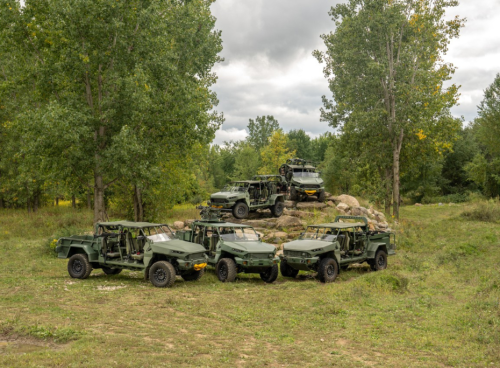
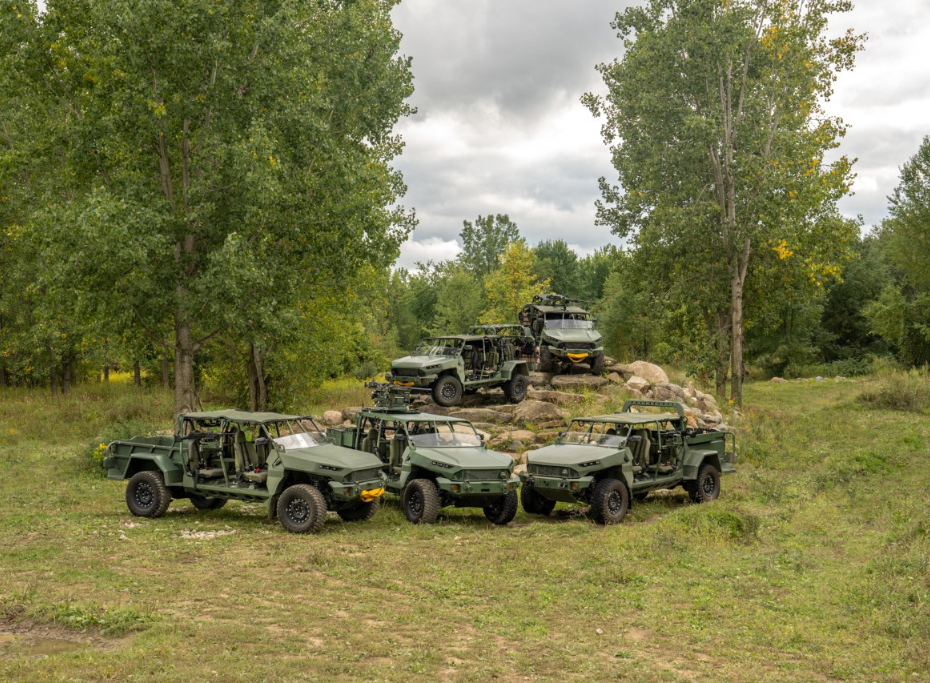
DND awards $35.8M Contract to GM Defense for Light Tactical Vehicles The Honourable Bill Blair, Minister of National Defence, announced that Canada is investing $35.8 million (including taxes) to deliver 90 Light Tactical Vehicles (LTVs) to Canadian Army personnel deployed in Latvia under Operation REASSURANCE – Canada’s mission in support of NATO’s assurance and deterrence measures. This announcement comes as Canada’s military footprint in Europe, including Latvia, is growing. As the Framework Nation for NATO’s Multinational Battle Group Latvia, soon to expand to NATO Multinational Brigade Latvia, Canada will have more than 2,200 soldiers persistently deployed by 2026. This new fleet of vehicles will enable the Canadian Army to operate more effectively in complex terrain and isolated locations that larger vehicles cannot access. They will also be used to transport combat equipment, which will reduce the loads carried by individual soldiers. To deliver these vehicles, Canada has finalized a contract with GM Defense Canada Company of Oshawa, Ontario, for 36 cargo and 54 personnel variants of the vehicle. The personnel variant is designed for teams of up to nine soldiers, while the cargo variant is designed for two to four soldiers and larger cargo. Light Forces equipped with a combination of cargo and personnel variants will be able to carry weapons, personal effects, and combat supplies for 72 hours of self-sufficient operation. The contract also includes integrated logistics support and up to two years of spare parts for the LTV fleet, as well as an option to procure up to an additional 18 LTV. The vehicles will be based on an off-the-shelf design so that they are delivered as quickly as possible. The first five vehicles are expected to arrive in Canada later this month, and will be used as the training fleet. Initial Cadre Training by the Canadian Army is expected to begin in late August 2024, with the remaining vehicles expected to arrive in Latvia by early October 2024. The LTV contract is the first phase of the Light Forces Enhancement (LFE) Project. LFE will deliver a specialized, new wheeled off-road vehicle capability to the Canadian Armed Forces’ Light Forces – which are rapidly deployable and optimized for terrain and conditions not suited to mechanized forces. The LFE Project Phase 2 will see up to 222 Tactical Mobility Platforms – also in cargo and personnel variants – and up to 23 light trailers, delivered to CA Regular and Reserve Forces in Canada. As the LFE project is in two phases, each will have a separate, competitive bidding process, which means different vehicles could be procured during each phase. “General Motors’ support of the Canadian Armed Forces with this contract is a prime example of the meaningful contributions GM makes in Canada. Whether it’s the supply of light tactical vehicles through GM Defense Canada, or the contributions of our Canadian Technical Centre in supporting the development of those vehicles, we are pleased GM can also make an impact in the defense space.” Kristian Aquilina, president and managing director of GM Canada “Canada’s commitment to Latvia’s security is steadfast. Through this procurement and other key investments, Canada is doing its part to help scale up the multinational NATO Battle Group in Latvia to a full-size brigade – strengthening our defensive and deterrent posture on the Alliance’s eastern flank. We will always do what it takes to provide Canadian Armed Forces members with the tools that they require to accomplish their increasingly vital missions.” The Honourable Bill Blair, Minister of National Defence “The procurement of the Light Tactical Vehicle for members of our Armed Forces deployed in Latvia is an example of our commitment to supporting the safety and modernization of our military, enabling it to better operate in a more complex and rapidly changing environment.” The Honourable Jean-Yves Duclos, Minister of Public Services and Procurement “This contract award demonstrate Canada’s steadfast commitment to bolstering our armed forces’ capabilities in Latvia. Our government is dedicated to equipping the Canadian Armed Forces with the equipment it needs to effectively carry out its mission, ensuring both immediate operational readiness and long-term economic benefits for Canadians. Through the application of Industrial and Technological Benefits Policy, this procurement will not only bolster Canadian innovation in our world class defence industry but also create high-value jobs and foster economic growth across the country.” The Honourable François-Philippe Champagne, Minister of Innovation, Science and Industry “The LTV contract is an important step toward revitalizing the Canadian Army (CA)’s Light Forces. It will enhance our range and response times both at home and abroad. Our Light Forces can be called to deploy on very short notice in any type of environment and the Army has been seeking that type of platform in larger numbers for many years. Once received, we intend to deploy most of these vehicles to Latvia in the fall. By being positioned on the eastern border of the Alliance, these platforms will enable the quick projection of a light infantry battle group to Latvia to reinforce the Forward Land Forces (FLF) Brigade led by Canada. Through this investment, the CA is not only improving its operational readiness, but is also enhancing its deterrence posture on the eastern flank of NATO.” Lieutenant-General Michael Wright, Commander Canadian Army GM Defense Canada’s light tactical vehicle solutions are based on the mid-size architecture of the Chevrolet Colorado ZR2, featuring a high percentage of Commercial-Off-The-Shelf (COTS) parts, including Chevrolet Performance components for enhanced off-road capability. Weighing less than 5000 pounds / 2232 kilograms, the light and agile tactical vehicles offer air transportability, in addition to ease of maintenance and sustainment with parts that may be accessed through GM’s global supply chain. Reliable and easy to operate, the light tactical vehicles also include active and passive safety features, meeting CAF requirements for performance and safety. ADDITIONAL INFO The Canadian Army’s Light Force infantry soldiers will be the primary users of the Light Tactical Vehicles and Tactical Mobility Platforms. The Light Forces Enhancement Project is split into two phases, and each will have a separate, competitive bidding process, which means different vehicles could be procured during each phase. Timelines for the second phase of this project will be confirmed as work progresses. The life expectancy for the new fleet is estimated at 15 years. Canada’s Industrial and Technological Benefits (ITB) Policy was applied to the LTV project in order to leverage economic benefits and grow the Canadian defence industry. GM Defense Canada Company will make targeted investments and business activity in Canada equal to the value of the contract. GM Defense Canada Company’s economic commitments are estimated to contribute $8.5 million annually to Canadian GDP and create or maintain 60 jobs annually over a five-year period. https://canadiandefencereview.com/dnd-awards-35-8m-contract-to-gm-defense-for-light-tactical-vehicles/