
Matthew
-
Posts
863 -
Joined
-
Last visited
Content Type
Profiles
Forums
Events
Everything posted by Matthew
-
 Also I love how you think this has been going on for 4 days. 😆
 -
Interesting. Is it not what you want?
-
Im from Iowa btw. Unlike most parliamentary systems the UK and Canada do have a lack of one person one vote proportionality. Citizen votes are not equal. But most other parliamentary systems are extremely focused on proportionality. So I think it would be difficult to sort out which is more representative of voters-- they each have their serious flaws. Unless you're one of the 538 electors you will never vote for the president. But i get what you're saying. Americans do have significant indirect influence on the outcome, though the fact that some citizens votes count far less than other citizens suggests an extreme failure of democracy. That's true, if you value land voting and having equal rights rather than citizens voting and having equal rights. Is that meant to be a question?
-
The current argument is just about facts. I'm outlining encyclopedic facts concerning the way in which the electoral college functions constitutionally and the respresentstional principles that are and are not by design not a part of the electoral college system within the framework of the republic. If the basic facts of reality were ever agreed to then I suppose an actual debate could occur about the merits of that system, or lack thereof.
-
Whatever system a state has for naming electors is completely independent from the electoral college system itself as outlined in the constitution. Your chess vs checkers analogy is closer to your own argument. You keep conflating the electoral college with the activities in the states to choose electors.You're falsely assuming that because the state level systems for choosing electors are democratic, that therefore the separate constitutional system for choosing a president via the electoral college is also democratic and the distribution of those electors is also democratic. Even the founders were quite open about it these things not being democratic, even though from the start there was a significant movement in some of the states to make the choosing of electors more directly democratic.
-
It should be pretty easy to quote me on that then, right?
-
This is not the electoral college. This is not the electoral college. This is not the electoral college. This is not the electoral college. This is the electoral college and those electors do not constitutionally have to vote the way their state voted and again the weighting of them is disproportional and therefore not democratic. You can focus on the states all you want but it won't ever help you to change the fact that at the national level the electoral college is not democratic even if the choosing of electors was.
-
I have not judged the electoral college system as being bad or good, Ive only described the simple facts of it being a non democratic system. It's just a basic fact and nobody knowledgeable about it would claim otherwise. I do think a proportional system would be better but I have made no argument to that point nor do I even have strong feelings on the subject.
-
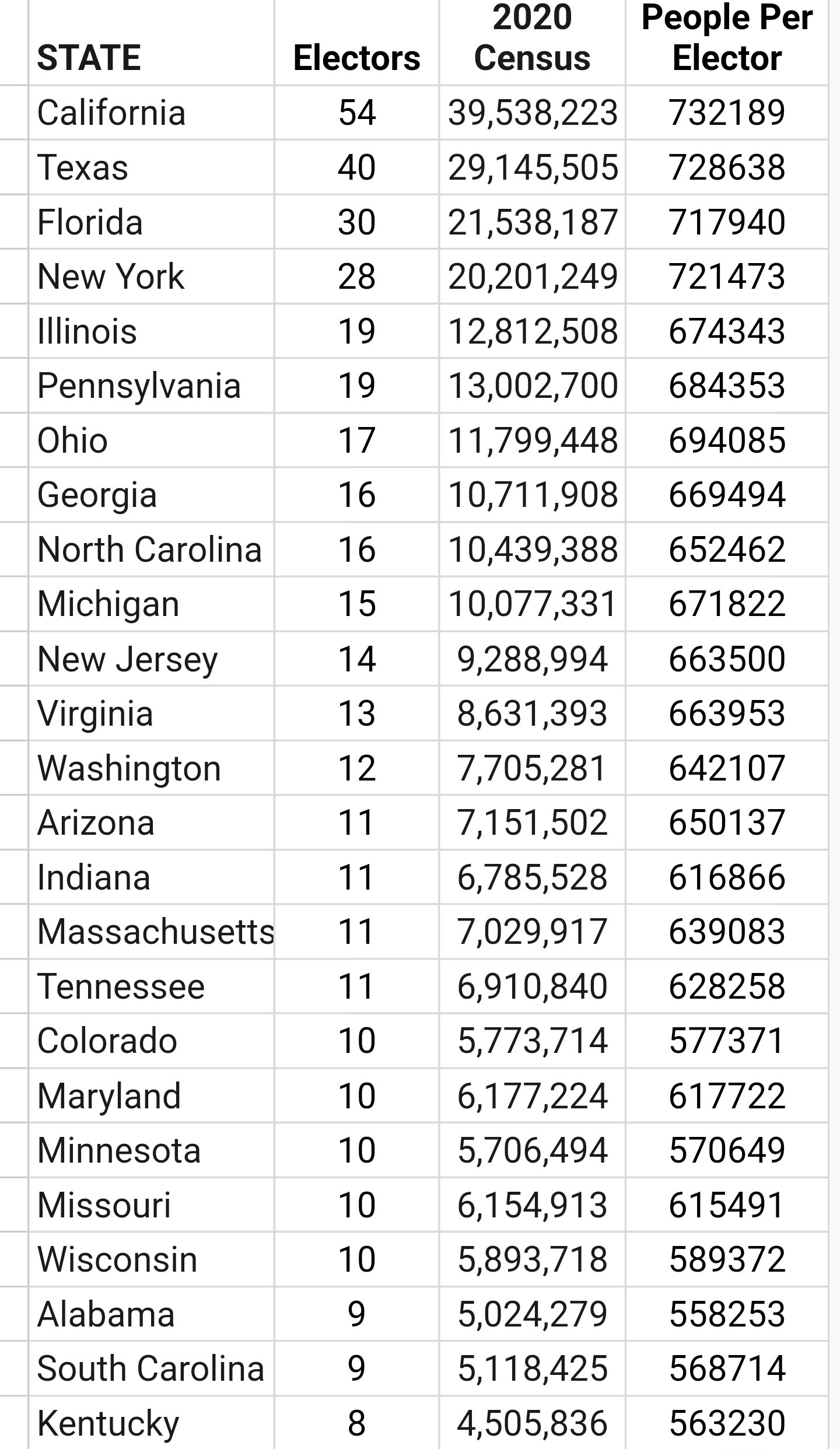
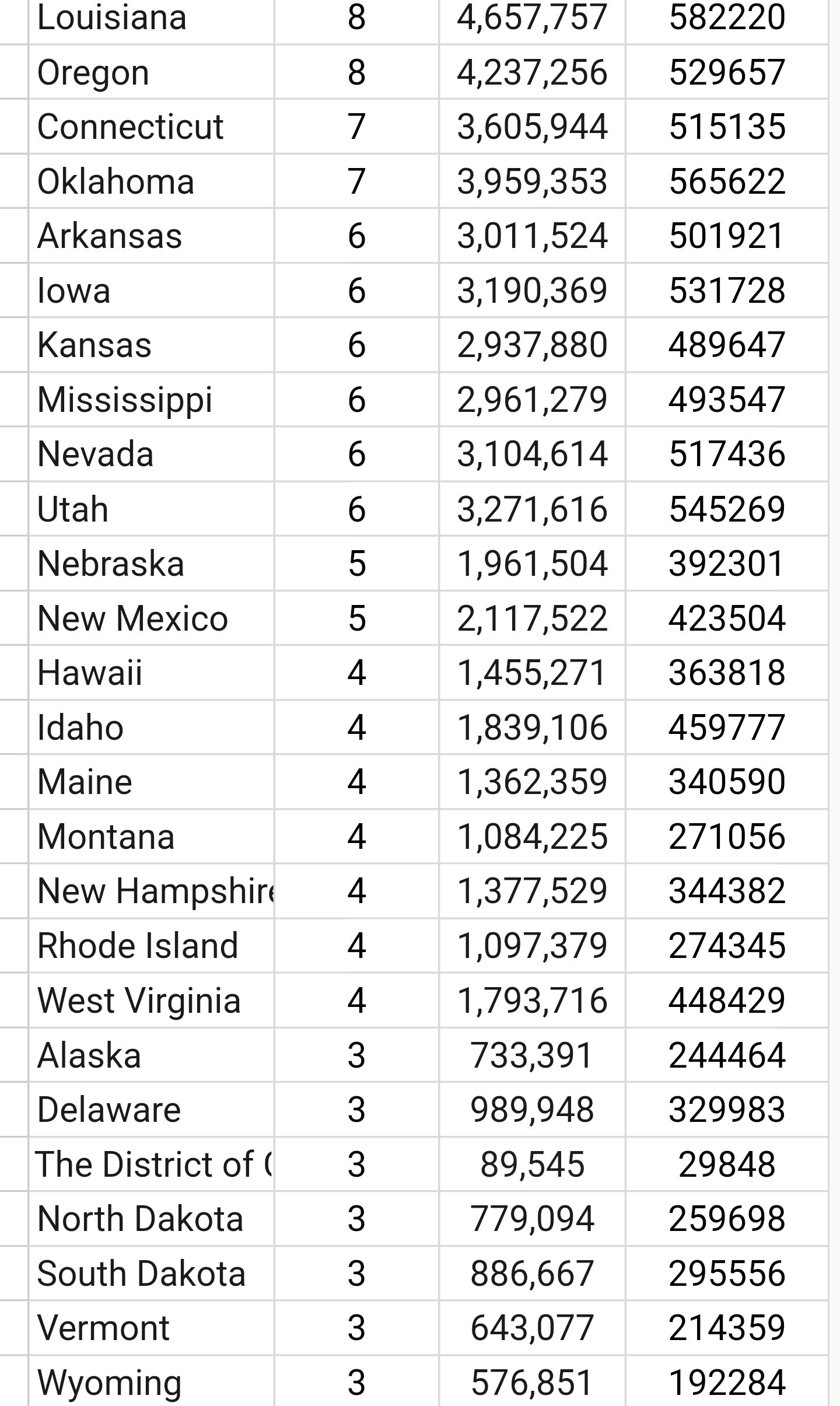
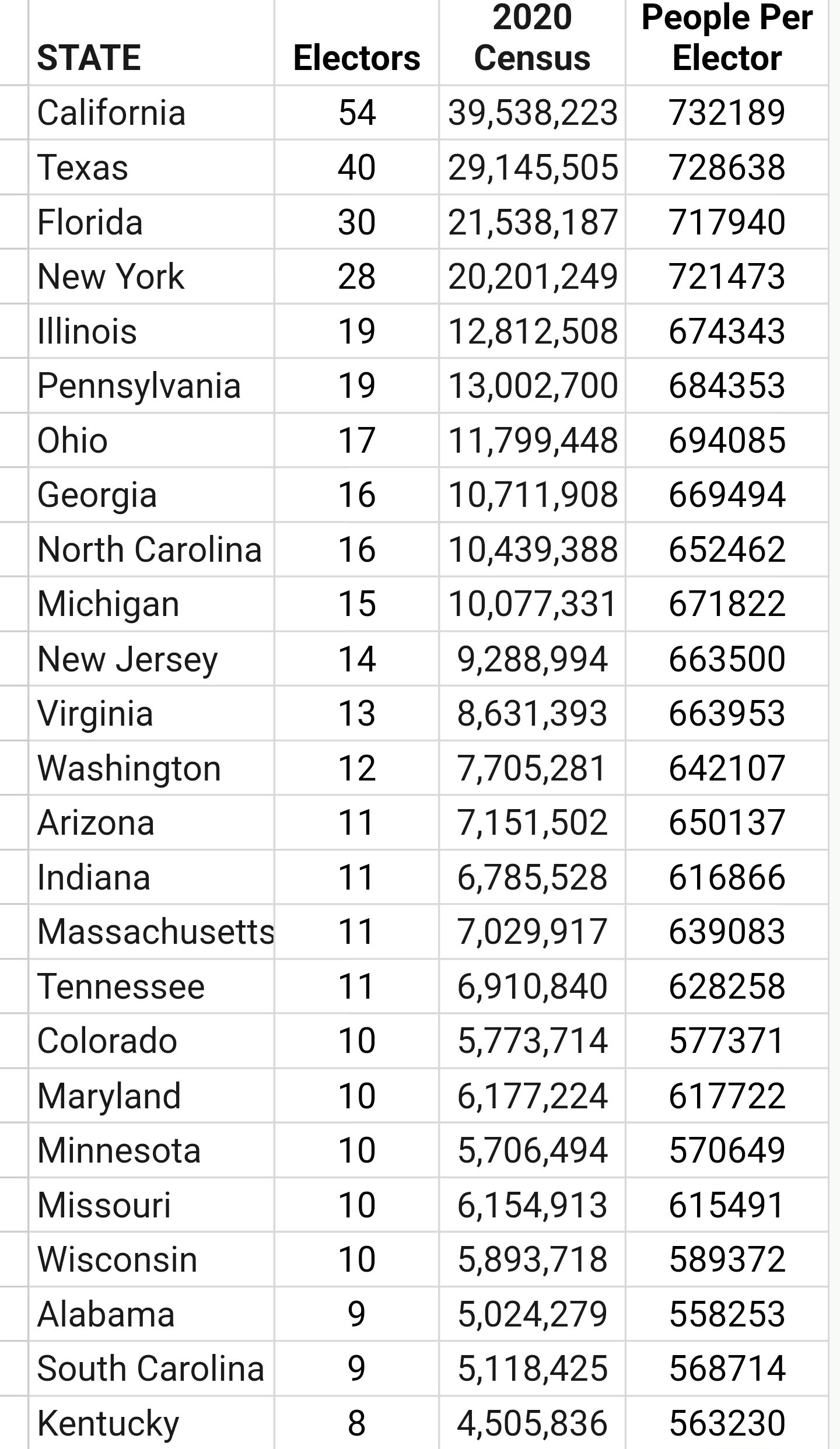
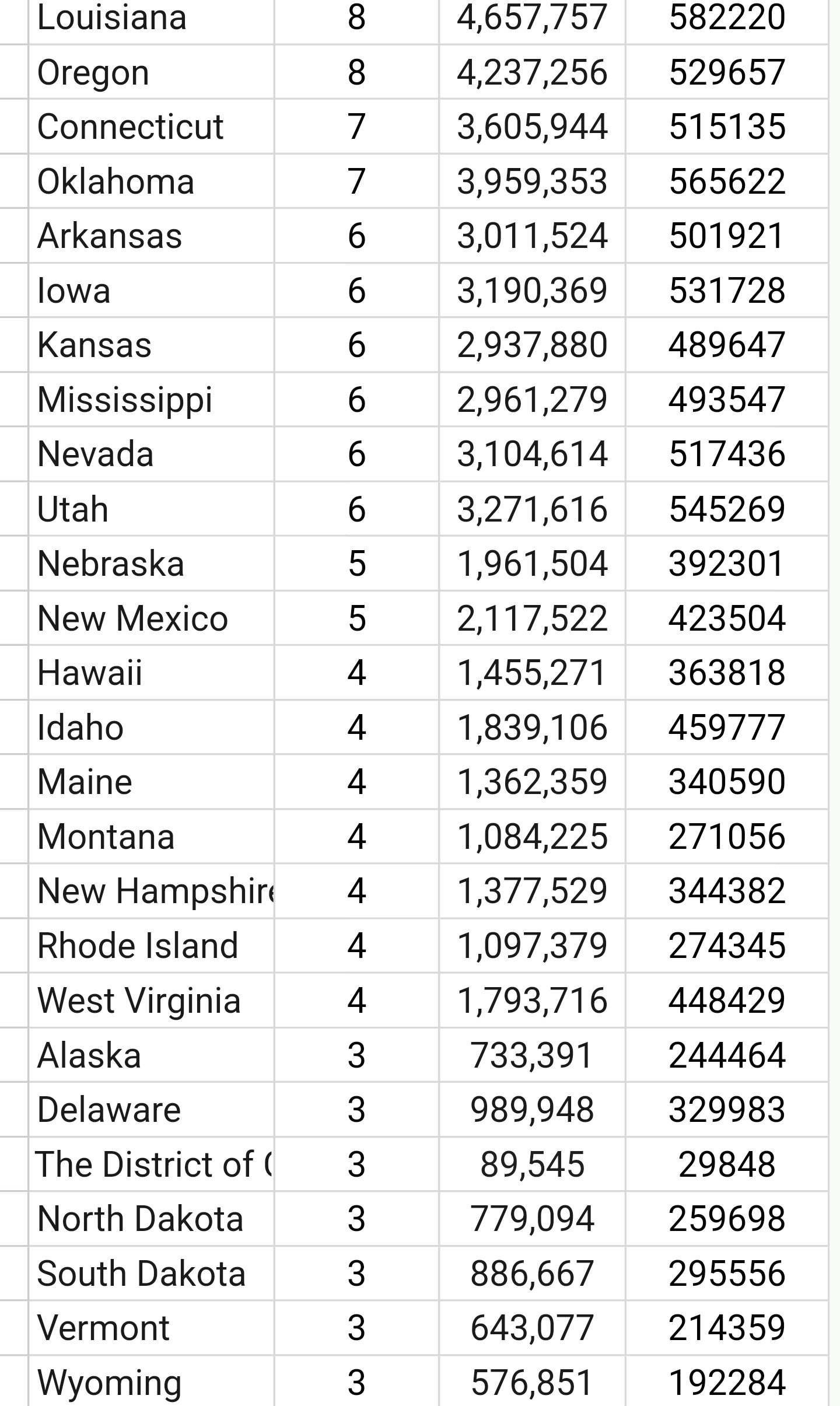
As you well know, only 81% of the electoral college is based on population and that is not enough for anyone trying to characterize the system as democratic. The Nov 5th vote in states is not the electoral college vote. The electoral college vote on Dec 17th does not follow the one person one vote principle because those electors represent vastly different numbers of citizens. You have falsely claimed. The numbers speak for themselves:
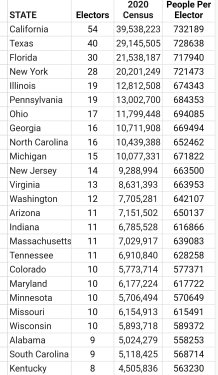
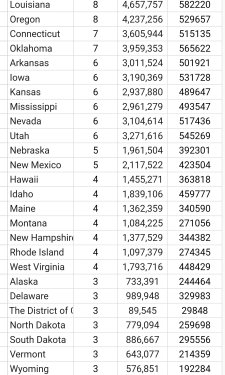
-
Right, says the guy who hasn't had any relevant argument in the thread for like 2 weeks.
-
The fact that some portion of electors is based on population is a given and beside the point. Overall these are the exact people per elector which shows that unlike democratic voting systems based on one person one vote, the electoral college is not based on a proprtional equal weighting of citizens.
-
Nope, unlike you i have no reason to lie in this thread. You refuse to acknowledge the disproportionate ratios of people per elector. Here are the exact ratios. Even absurdly claiming that the people per electors is proportional.
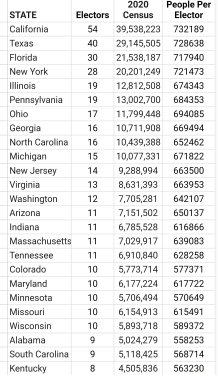
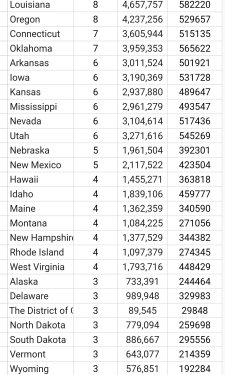
-
I really doubt this now. I've found you to be at worst an annoying dumbass a few times in past disagreements but I hadn't realized until the post before last that you were so egregiously deceptive and arguing in bad faith. Yes, you've made statements that you know full well are not true and posted responses to things that you knew were not relevant to the thing you were responding to.
-
Intestesting. So you're willing to have days on days of bad faith discussion with someone knowing what you're currently saying is dishonest. Just another day in trump land I guess? Ah the person actively hiding their true position and lying is now going to call the other person dishonest. Very nice. So you admit to being a spiteful troll. You will know them by their fruits indeed. Ive had similar discussions with people for decades. In the last 248 years there have more proposed constitutional amendments related to the electoral college than any other topic. People around the world-- even people with actual democratic voting systems-- very often want greater proportionality and work towards getting it. So if you think this is a recent or localized opinion you're wrong. As far as donald trump, he isnt my preference but if he wins I'll be fine. I've been watching republicans degrade and weaken the country since at least the 1980s. I'm used to it.
-
Ok with that I now see that you are in fact actively avoiding a direct and honest conversation. Again conservatives for centuries have not relied on this kind of bullshit doubletalk and hiding their true position on this issue. That's false and you know it. The fact that you can't show states having the same proportion of electors to citizens is proof positive that your statement and entire argument is false. State voting is not the electoral college vote. Which you know and are again avoiding.
-
No this does not support your claim that "The amount of electors awarded per person is proportional." That's the calculation for apportionment of districts. It does not account for 19% of the electors. You need to pick two states and show me what the electors per person ratio is according to your understanding. No "one person one vote" is about PEOPLE voting. Instead of giving the ratio to people, you have the ratio to a state. So either you're incredibly dense or you're avoiding what can clearly see is disproportionate elector-person ratios. Either you believe the land is voting or you believe the people are voting. So far you've been pretty clear that it's the states voting and not the people, thus supporting my argument.
-
Longstanding autonomous colonial governments did not want to give up power. So they created a system to continue semiautonomous provincial governments. Any more irrelevant questions?
-
Really? Lets see how you figure that. What are two states and their elector per person proportions in the way that you're thinking about this? Ah we're full circle now. So you admit then that it's states voting and not citizens in the electoral college? Because you're giving the ratio per state and not the ratio per citizen. All this jerking around about one person one vote and democracy is moot then, right?
-
Yep, I'm with you here. We're talking about a US election system so the meaning of electoral principles from those sources is informative. Yes it's an important principle. The intent of my question here wasnt to be snide. You seem to be spending a lot of time and energy bickering about this issue but it's not clear how it relates to any actual argument of yours. The only clear point you've ever made with it is that the state contest to choose electors follows the one person one vote principle. I've never disagreed with that and it doesn't contradict or relate to my own point in terms of how I've applied this principle. Proportionality is a ratio. The ratio of citizens per elector does differ. This is a dumb and simplistic thing for you to disagree about. We could literally make a list of the ratios for each state and most of them would not be similar. The number 2 is not a ratio. The ratio is people per elector.
-
Riiight. You do a lot of lengthy stream-of-consciousness word vomit that doesn't directly pertain to much and is often untethered to reality. So if you ever have anything import to say help us all out by just leading with that. 😄
-
Well i always give you one or two sentences to demonstrate that you're going to be on point and not post worthless garbage. You typically fail that threshold. It's been weeks since I've read more than your opening sentences.
-
Nope. There certainly is useful case law about its meaning in the US, which is relevant to this discussion. But I would never claim that any basic principle of democracy is exclusively American. What is your actual point about the "one person one vote" principle? I have no dispute that the choosing of electors follows that principle. But the actual vote of 538 electors for president obviously fails this principle due to the disproportionate weighting of those electors per citizens being represented. Proportional means that as the states population goes up, the number of Electors would go up by the same ratio. Here is simple and precise definition: "Proportionality, In algebra, equality between two ratios. In the expression a/b = c/d, a and b are in the same proportion as c and d...The term proportionality describes any relationship that is always in the same ratio. The number of apples in a crop, for example, is proportional to the number of trees in the orchard, the ratio of proportionality being the average number of apples per tree." Based on this definition, giving each state no matter their population two electoral votes would not be proportional.
-
I try to only respond to things that are germane to the topic and argument at hand. And no I keep waiting for the real argument to begin but I think I'm dealing with the C squad here.
-
Thanks for helping to support my point about the lack of rational thought among current conservatives.
-
What's most amusing is that you guys haven't even offered the actual conservative argument for the electoral college and instead have opted to try to deny facts and try to redefine them, which has gotten you nowhere. Its such an artifact of our time that the right wing is now so inept at making intellectually robust and honest conservative arguments and instead relies entirely on lies and disinformation.